UnitedHealth Group Statistics and Facts
By Emily Martin
Company Profile
|
Profile Detail
|
Information
|
|
Company Name
|
UnitedHealth Group Incorporated
|
|
Category / Industry
|
Health care, managed care, health insurance, pharmacy benefit management, health technology, and health services
|
|
Company Type
|
Public
|
|
CEO
|
Stephen J. Hemsley, Chair and Chief Executive Officer
|
|
CFO
|
Wayne DeVeydt, Chief Financial Officer
|
|
Founder
|
Richard Taylor Burke
|
|
Founded Year
|
1974 as Charter Med Incorporated, later restructured as United Healthcare Corporation in 1977
|
|
Headquarters
|
1 Health Drive, Eden Prairie, Minnesota, United States
|
|
Stock Symbol
|
NYSE: UNH
|
|
Number of Employees
|
More than 390,000 employees as of December 31, 2025
|
|
Annual Revenue
|
USD 447.6 billion in 2025
|
|
Net Income
|
USD 12.8 billion in net earnings in 2025
|
|
Total Assets
|
USD 309.6 billion as of December 31, 2025
|
|
Products / Services
|
Health benefits, Medicare plans, Medicaid managed care, employer and individual plans, pharmacy benefit management, care delivery, data analytics, health technology, payment services, care management, and health financial services
|
|
Key Brands
|
UnitedHealthcare and Optum
|
|
Competitors
|
CVS Health, The Cigna Group, Elevance Health, Humana, Centene, Molina Healthcare, Kaiser Permanente, and regional Blue Cross Blue Shield plans
|
|
Subsidiaries
|
UnitedHealthcare, Optum Health, Optum Insight, Optum Rx, Change Healthcare, and other operating entities
|
|
Website
|
unitedhealthgroup.com
|
|
Geographical Presence
|
Primarily the United States, with selected international operations and a recent focus on simplifying non-U.S. exposure
|
Introduction
UnitedHealth Group is one of the largest health care companies in the United States and across the global health services sector. The company operates through two main platforms, UnitedHealthcare and Optum. UnitedHealthcare provides health benefits and managed care coverage, while Optum provides care delivery, pharmacy services, analytics, health technology, and operating support for the health system.
The company has strong importance in the U.S. health care system because it serves employers, individuals, Medicare members, Medicaid beneficiaries, care providers, pharmacies, governments, and life sciences clients. Its scale makes it a major reference point for health insurance demand, pharmacy benefit activity, claims processing, digital health adoption, and care delivery trends.
UnitedHealth Group’s service portfolio is broad and includes employer health plans, individual plans, Medicare Advantage, Medicaid managed care, pharmacy benefit management, specialty pharmacy, care management, health data services, payment systems, and consumer health financial tools. This mix allows the company to participate in several parts of the health care value chain.
Its statistics are useful for industry readers because they show how a large integrated health care company responds to medical cost pressure, regulation, digital operations, customer expectations, and technology adoption. The company’s revenue, membership, employee base, pharmacy volume, web traffic, and ownership structure provide a clear view of its market position in 2026.
Editor’s Choice
- UnitedHealth Group generated USD 447.6 billion in total revenue in 2025, compared with USD 400.3 billion in 2024.
- The company reported USD 111.7 billion in Q1 2026 revenue, compared with USD 109.6 billion in Q1 2025.
- UnitedHealth Group had more than 390,000 employees at the end of 2025, including nearly 165,000 clinical professionals.
- UnitedHealthcare served 49.1 million people in Q1 2026, while Optum supported more than 122 million consumers across its businesses.
- UnitedHealthcare revenue reached USD 344.9 billion in 2025, making it the largest operating platform by revenue inside the group.
- Optum revenue reached USD 270.6 billion in 2025 before eliminations, supported by Optum Health, Optum Insight, and Optum Rx.
- Optum Rx processed 383 million adjusted scripts in Q1 2026, compared with 408 million in Q1 2025.
- UnitedHealth Group’s Q1 2026 medical care ratio was 83.9%, compared with 84.8% in Q1 2025.
- UnitedHealth Group website recorded an estimated 18.9 million visits in April 2026 and ranked #5 in the U.S. Insurance category, according to Similarweb estimates.
- In Q1 2026, UnitedHealth Group completed the sale of Optum UK and committed USD 400 million in net proceeds to the United Health Foundation.
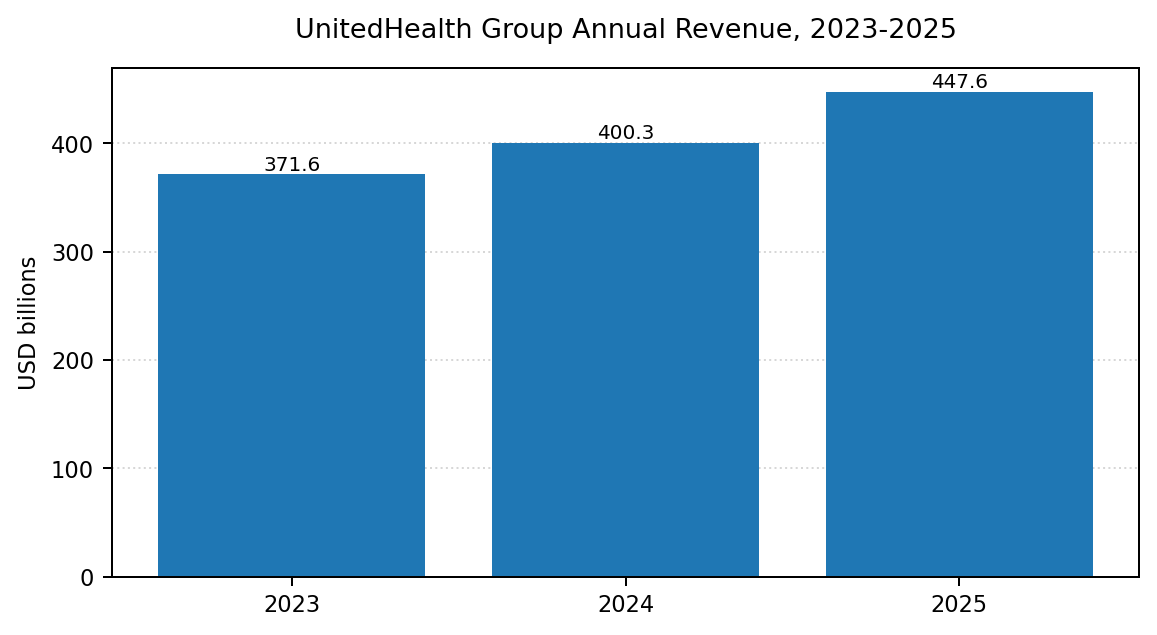
UnitedHealth Group annual revenue, 2023-2025.
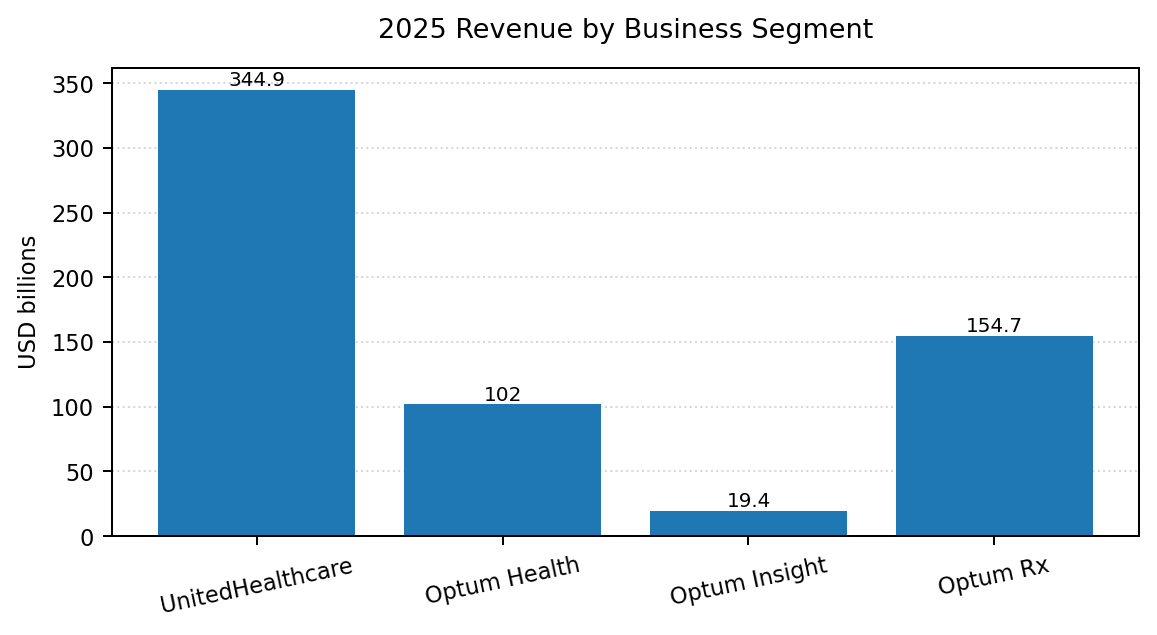
2025 revenue by business segment. Segment figures are before eliminations and are not additive to consolidated revenue.
Historical Facts
- 1974: Richard Taylor Burke founded Charter Med Incorporated in Minnesota, which became the early foundation of UnitedHealth Group.
- 1977: United Healthcare Corporation was formed to develop a network-based health plan model.
- 1984: UnitedHealthcare became a publicly traded company, which supported national expansion through public capital markets.
- Late 1980s: The company entered pharmacy benefit management through Diversified Pharmaceutical Services, showing early expansion beyond traditional insurance.
- 1990s: UnitedHealthcare expanded through health plan acquisitions and broader employer coverage offerings across the United States.
- 1998: The company adopted the UnitedHealth Group name to reflect a broader business mix beyond health insurance.
- 2000s: UnitedHealth Group increased its national health benefits presence and invested more deeply in technology and data capabilities.
- 2011: Optum was launched as a health services brand focused on care delivery, pharmacy services, analytics, and technology.
- 2022: UnitedHealth Group completed the acquisition of Change Healthcare after regulatory review, expanding payment and health technology capabilities.
- 2024: Change Healthcare experienced a major cyberattack that disrupted claims and payment systems across the U.S. health care market.
- 2025: Stephen J. Hemsley returned as CEO, and Wayne DeVeydt became CFO during a period of portfolio review and operational refocus.
- 2026: The company reported Q1 revenue of USD 111.7 billion, sold Optum UK, and entered into an agreement to acquire Alegeus Technologies.
General Statistics and Facts
- UnitedHealth Group operates through two major platforms, UnitedHealthcare and Optum.
- UnitedHealthcare includes Employer & Individual, Medicare & Retirement, and Community & State businesses.
- Optum includes Optum Health, Optum Insight, and Optum Rx.
- The company’s 2025 revenue was USD 447.6 billion, supported mainly by premium revenue, product revenue, and service revenue.
- Premium revenue was USD 352.2 billion in 2025, making it the largest revenue category.
- Product revenue was USD 53.4 billion in 2025, mainly tied to pharmacy and related services.
- Service revenue was USD 38.0 billion in 2025, reflecting administrative, technology, and health services activity.
- UnitedHealthcare served 49.1 million medical consumers in Q1 2026.
- Optum supported more than 122 million consumers across its businesses in Q1 2026.
- The company had more than 390,000 employees at the end of 2025.
- Nearly 165,000 employees were clinical professionals at the end of 2025.
- The company’s business model combines insurance risk, fee-based benefits administration, pharmacy services, care delivery, technology services, and data analytics.
- UnitedHealth Group has been refocusing on U.S. health care and simplifying selected non-U.S. business exposure.
- Its competitive position is supported by large membership, health plan scale, pharmacy volume, care delivery capabilities, and health data assets.
- The company faces major operating risks from medical cost trends, cyber risk, regulatory pressure, member retention, and health care affordability concerns.
Revenue Statistics
- UnitedHealth Group revenue reached USD 447.6 billion in 2025, compared with USD 400.3 billion in 2024 and USD 371.6 billion in 2023.
- The company’s consolidated 2025 revenue increased by about 12% from 2024.
- Q1 2026 revenue was USD 111.7 billion, up 2% from USD 109.6 billion in Q1 2025.
- UnitedHealthcare revenue was USD 344.9 billion in 2025, compared with USD 298.2 billion in 2024.
- Optum revenue was USD 270.6 billion in 2025 before corporate eliminations, compared with USD 253.0 billion in 2024.
- Optum Health revenue was USD 102.0 billion in 2025.
- Optum Insight revenue was USD 19.4 billion in 2025.
- Optum Rx revenue was USD 154.7 billion in 2025.
- UnitedHealth Group reported USD 19.0 billion in 2025 earnings from operations.
- Net earnings were USD 12.8 billion in 2025, compared with USD 15.2 billion in 2024.
Growth Statistics
- Total revenue increased by USD 47.3 billion from 2024 to 2025.
- UnitedHealthcare revenue grew from USD 298.2 billion in 2024 to USD 344.9 billion in 2025.
- Optum revenue increased from USD 253.0 billion in 2024 to USD 270.6 billion in 2025.
- UnitedHealthcare commercial fee-based membership increased by about 600,000 in 2025 compared with 2024.
- UnitedHealthcare Employer & Individual Q1 2026 revenue was USD 20.1 billion, compared with USD 19.8 billion in Q1 2025.
- UnitedHealthcare Community & State Q1 2026 revenue was USD 24.1 billion, compared with USD 23.1 billion in Q1 2025.
- Optum Rx Q1 2026 revenue reached USD 35.7 billion, up from USD 35.1 billion in Q1 2025.
- The company’s Q1 2026 operating cost ratio was 13.8%, reflecting technology, process, and artificial intelligence investments.
- The agreement to acquire Alegeus Technologies supports UnitedHealth Group’s growth in consumer-directed health account administration.
- The business strategy in 2026 is centered on U.S. health care focus, operational efficiency, technology modernization, portfolio simplification, and better member and provider experiences.
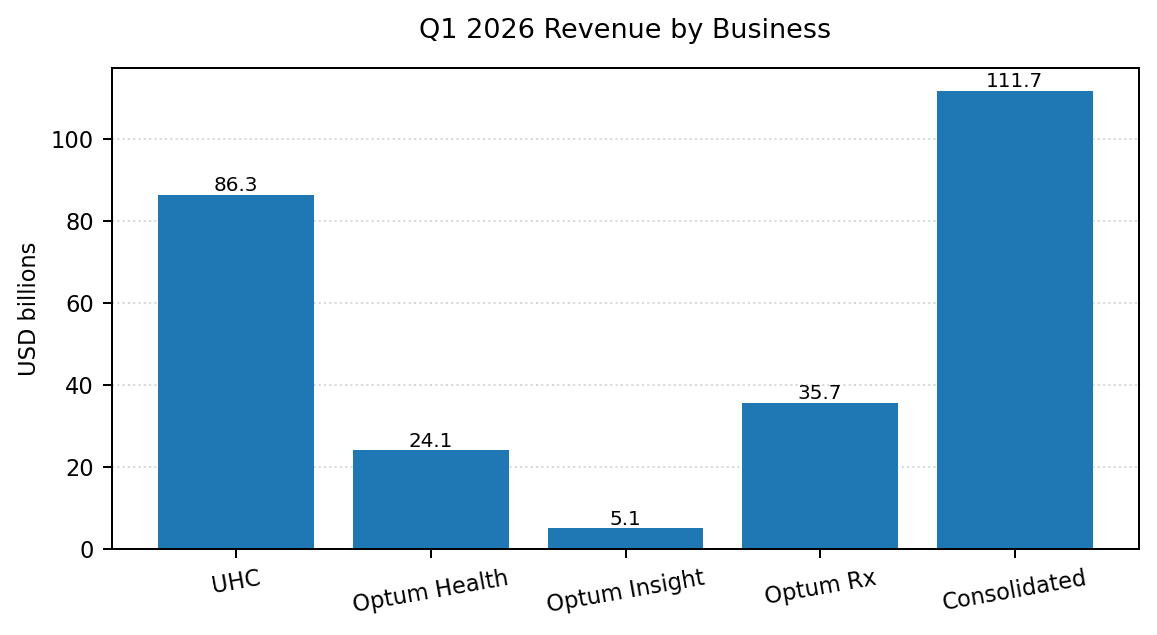
Q1 2026 revenue by business. Figures are before eliminations except consolidated revenue.
Regional Statistics
- The United States remains the company’s main revenue base and operating center.
- UnitedHealth Group is headquartered in Eden Prairie, Minnesota.
- North America, especially the United States, contributes the highest demand and revenue for the company.
- The company’s domestic income before income taxes was USD 14.9 billion in 2025, while foreign income before income taxes was negative USD 196 million.
- UnitedHealthcare Employer & Individual domestic revenue was USD 75.9 billion in 2025.
- UnitedHealthcare Employer & Individual global revenue was USD 3.3 billion in 2025, down from USD 3.7 billion in 2024.
- In Q1 2026, UnitedHealth Group completed the sale of Optum UK, reflecting a sharper focus on core U.S. health care operations.
- The company’s U.S. government program demand is tied to Medicare, Medicaid, and related public-sector coverage programs.
- International activity remains selective and more limited compared with the company’s U.S. operations.
- Regional risk remains linked to U.S. health policy, CMS rates, state Medicaid contracts, employer plan demand, and consumer affordability.
Product / Service Statistics
- UnitedHealthcare offers employer-sponsored plans, individual plans, Medicare Advantage, Medicare Supplement, Part D, Medicaid managed care, and administrative services.
- UnitedHealthcare Q1 2026 revenue reached USD 86.3 billion.
- UnitedHealthcare Medicare & Retirement Q1 2026 revenue reached USD 42.1 billion.
- UnitedHealthcare Employer & Individual Q1 2026 revenue reached USD 20.1 billion.
- UnitedHealthcare Community & State Q1 2026 revenue reached USD 24.1 billion.
- Optum Health Q1 2026 revenue was USD 24.1 billion.
- Optum Insight Q1 2026 revenue was USD 5.1 billion.
- Optum Rx Q1 2026 revenue was USD 35.7 billion.
- Optum Rx processed 383 million adjusted scripts in Q1 2026.
- Optum services include value-based care, health analytics, payment tools, claims support, pharmacy care, and health technology.
Sales Statistics
- UnitedHealth Group’s sales are recorded through premiums, product revenue, service revenue, and investment or other income.
- Premium revenue reached USD 352.2 billion in 2025, making it the company’s main sales category.
- Product revenue reached USD 53.4 billion in 2025, largely connected with pharmacy operations.
- Service revenue reached USD 38.0 billion in 2025.
- UnitedHealthcare generated USD 332.4 billion in premium revenue from unaffiliated customers in 2025.
- Optum Rx generated USD 52.9 billion in unaffiliated product revenue in 2025.
- UnitedHealthcare sales are supported by risk-based health insurance, Medicare, Medicaid, commercial coverage, and fee-based administrative contracts.
- Optum Rx sales are supported by pharmacy benefit management, specialty pharmacy, home delivery, and prescription volume.
- Optum Insight sales are driven by health technology, analytics, payment solutions, and administrative services.
- Optum Health sales are linked to care delivery, value-based care, clinical services, and care management.
Competitors and Market Share
- UnitedHealth Group competes with CVS Health, The Cigna Group, Elevance Health, Humana, Centene, Molina Healthcare, Kaiser Permanente, and regional Blue Cross Blue Shield plans.
- UnitedHealth Group reported USD 447.6 billion in 2025 revenue, placing it among the highest-revenue companies in health care.
- CVS Health reported USD 402.1 billion in 2025 total revenues and competes through Aetna, Caremark, retail pharmacy, and care delivery.
- The Cigna Group reported USD 274.9 billion in 2025 total revenues and competes through health benefits and Evernorth services.
- Elevance Health reported USD 197.6 billion in 2025 operating revenue and competes strongly in commercial, Medicaid, Medicare, and Carelon services.
- Humana remains a major Medicare Advantage competitor and reported full-year 2025 results with strong focus on margin recovery and senior care.
- UnitedHealth Group has a broader business mix than many peers because it combines insurance, care delivery, pharmacy services, data, payment tools, and technology.
- UnitedHealthcare has large scale in commercial, Medicare, and Medicaid coverage.
- Optum improves the company’s competitive reach because it serves payers, providers, employers, governments, pharmacies, life sciences firms, and consumers.
- Competitive pressure remains high due to medical cost trends, pharmacy benefit management scrutiny, pricing discipline, member retention, and regulatory oversight.
Shareholders or Ownership Statistics
- UnitedHealth Group is listed on the NYSE under the ticker symbol UNH.
- The company had 908,213,180 shares of common stock issued, outstanding, and entitled to vote as of April 2, 2026.
- The Vanguard Group was listed in the 2026 proxy statement with 91,802,960 shares, equal to 10.11% of common stock, based on Schedule 13G information disclosed in the proxy.
- BlackRock, Inc. was listed with 72,595,811 shares, equal to 7.99% of common stock.
- The 2026 proxy statement listed Vanguard and BlackRock as shareholders known to beneficially own more than 5% of outstanding common stock.
- Public ownership is broad, with major holdings likely spread across index funds, pension funds, mutual funds, and institutional portfolios.
- Berkshire Hathaway sold its UnitedHealth stake in Q1 2026, according to Reuters reporting.
- Public shareholders participate through annual meetings, proxy voting, board elections, and governance proposals.
Patents or Innovation Statistics
- UnitedHealth Group’s innovation activity is focused on health technology, analytics, pharmacy operations, claims processing, payment tools, care coordination, and AI-enabled process improvement.
- The Q1 2026 operating cost ratio reflected investments in people, processes, technology, and artificial intelligence.
- Optum Insight provides analytics, technology, payment, and operational services for health system participants.
- Optum Rx supports pharmacy innovation through specialty pharmacy, home delivery, formulary management, drug adherence tools, and pharmacy benefit design.
- UnitedHealthcare announced a 2026 effort to standardize prior authorization requirements, with more than 70% of prior authorization volume expected to be included by year-end.
- Patent databases list UnitedHealth Group assigned patents in health data analysis, predictive modeling, care management, and administrative systems.
- AI adoption is expected to support prior authorization, claims review, coding analysis, call center operations, payment accuracy, and provider support.
- Innovation must be managed with privacy, clinical accuracy, cybersecurity, fairness, compliance, and patient trust controls.
Collaboration and Partnership Statistics
- UnitedHealth Group works with employers, health systems, physician groups, pharmacies, governments, technology suppliers, and community organizations.
- UnitedHealthcare partners with employers and public-sector programs to provide health benefits and administrative services.
- Optum works with payers, care providers, employers, governments, life sciences companies, pharmacies, and consumers.
- The Alegeus Technologies acquisition agreement announced in Q1 2026 supports benefit account administration and consumer-directed health tools.
- The Optum UK sale resulted in USD 400 million in net proceeds committed to the United Health Foundation.
- UnitedHealthcare’s prior authorization standardization initiative reflects broader health care coordination around administrative simplification.
- The company works with CMS and state Medicaid agencies through Medicare Advantage, Medicaid managed care, and related government programs.
- Technology and supplier partnerships remain important because the company operates large claims, pharmacy, payment, and data platforms.
User or Customer Demographics
- UnitedHealthcare served 49.1 million medical consumers in Q1 2026.
- Total commercial people served were 30.1 million in Q1 2026.
- Total community and senior people served were 19.0 million in Q1 2026.
- Medicare Advantage people served were 7.6 million in Q1 2026.
- Medicaid people served were 7.2 million in Q1 2026.
- Optum Health served 93 million consumers in Q1 2026.
- Optum Rx processed 383 million adjusted scripts in Q1 2026.
- Similarweb estimated that uhc.com’s audience was 66.6% female and 33.4% male in April 2026.
- Similarweb estimated that the largest uhc.com visitor age group was 45 to 54 in April 2026.
- The United States represented 98.4% of uhc.com desktop traffic by country in April 2026, according to Similarweb estimates.
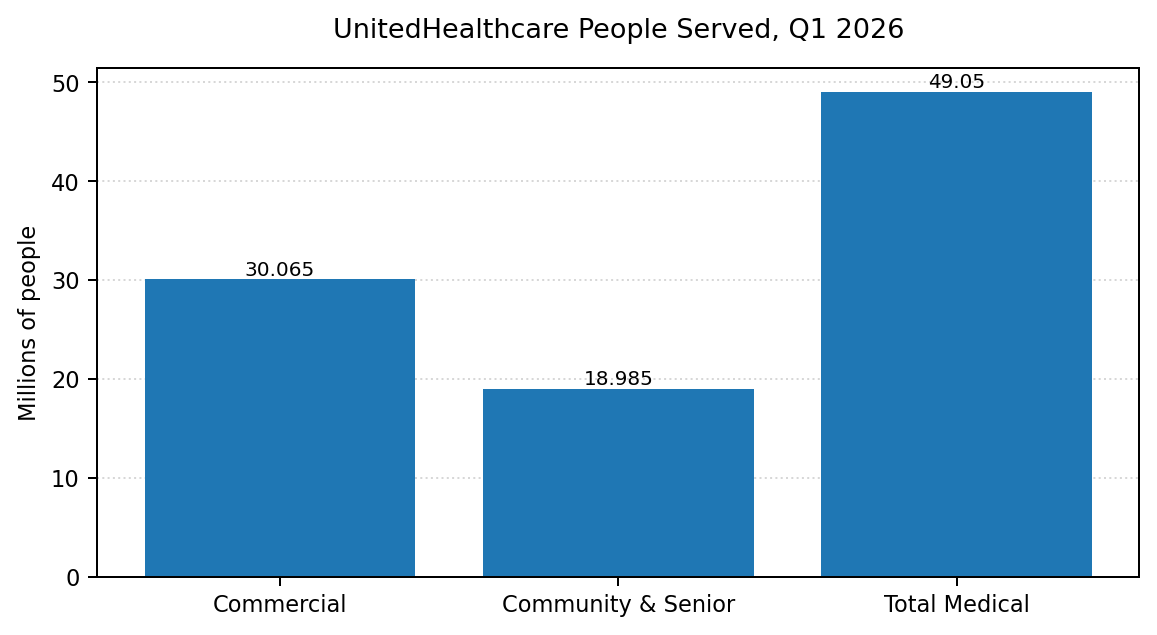
UnitedHealthcare people served in Q1 2026.
Website and Social Media Traffic Statistics
- UnitedHealthcare website ranked #5 in the U.S. Insurance category in April 2026, according to Similarweb estimates.
- UnitedHealthcare website ranked #1,759 globally in April 2026.
- UnitedHealthcare website recorded an estimated 18.9 million total visits in April 2026.
- The site’s estimated bounce rate was 25.58% in April 2026.
- Pages per visit were estimated at 7.24 in April 2026.
- Average visit duration was estimated at 5 minutes and 42 seconds in April 2026.
- Direct traffic was the top desktop traffic source, contributing 36.27% of visits in April 2026.
- Organic search was the second-largest desktop traffic source, and referrals were the third-largest source.
- United States desktop traffic share was estimated at 98.4% in April 2026.
- Similarweb listed aetna.com, humana.com, cigna.com, anthem.com, wellcare.com, bcbs.com, ehealthinsurance.com, medicare.gov, healthcare.gov, and umr.com among comparable sites.
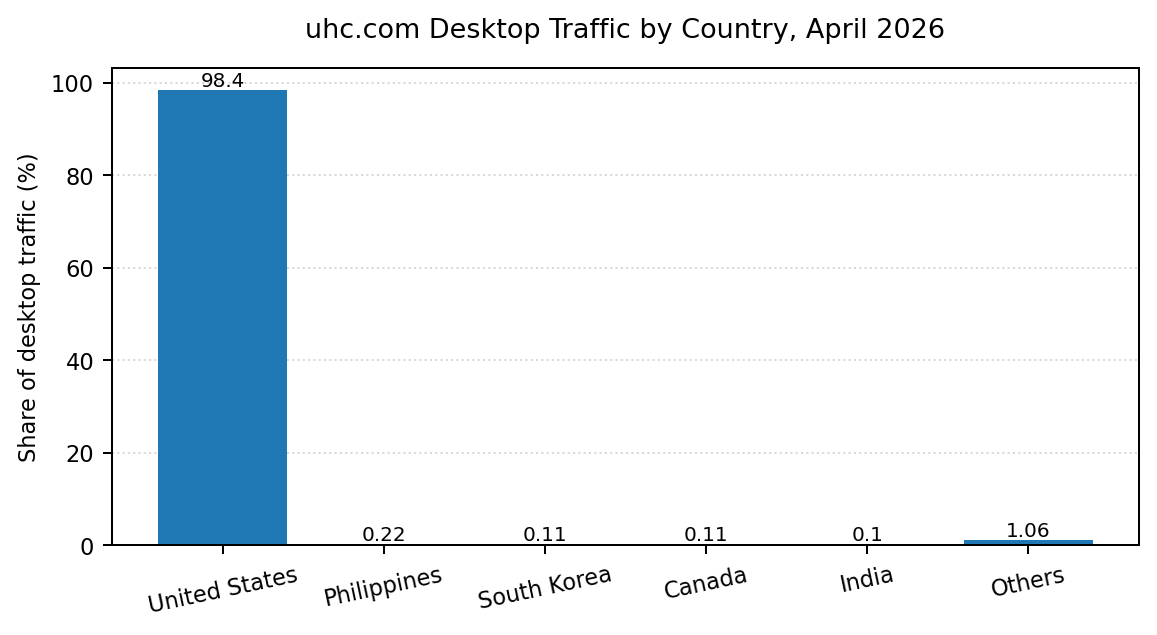
uhc.com desktop traffic country mix, April 2026. Data are Similarweb estimates.
Employee Statistics
- UnitedHealth Group had more than 390,000 employees as of December 31, 2025.
- Nearly 165,000 employees were clinical professionals at the end of 2025.
- The workforce includes nurses, physicians, pharmacists, technologists, actuaries, analysts, claims specialists, customer service teams, and corporate professionals.
- The company stated that its employees are guided by values including integrity, compassion, inclusion, relationships, innovation, and performance.
- Hiring and retention remain important because health care and technology talent markets are competitive.
- The availability of hybrid and remote working arrangements has increased competition for skilled employees and executives.
- Stephen J. Hemsley returned as CEO in 2025, while Wayne DeVeydt became CFO.
- Tim Noel served as CEO of UnitedHealthcare in 2026.
- Patrick Conway served as CEO of Optum in 2026.
- Employee productivity is supported by technology investment, process improvement, compliance training, clinical quality programs, and leadership development.
Fun Facts
- UnitedHealth Group began as Charter Med Incorporated before becoming United Healthcare Corporation.
- The company changed its name to UnitedHealth Group as its business expanded beyond traditional health insurance.
- Optum was launched as a separate brand in 2011 and became one of the largest health services platforms in the United States.
- The company’s headquarters address is 1 Health Drive, which reflects its health care identity.
- UnitedHealth Group’s two main brands serve different purposes: UnitedHealthcare is focused on benefits, while Optum is focused on health services.
- Optum Rx processed 383 million adjusted scripts in Q1 2026, showing the scale of the company’s pharmacy activity.
- UnitedHealthcare served more people in Q1 2026 than the population of many countries.
- The company’s operations touch several parts of the health care system, including insurance, care delivery, pharmacy, payments, data, and technology.
Recent Developments
- In January 2026, UnitedHealth Group reported 2025 revenue of USD 447.6 billion and issued its 2026 outlook.
- In Q1 2026, the company reported USD 111.7 billion in revenue and USD 9.0 billion in earnings from operations.
- The company raised its full-year 2026 adjusted earnings outlook to more than USD 18.25 per share.
- UnitedHealth Group completed the sale of Optum UK in Q1 2026 and committed USD 400 million in net proceeds to the United Health Foundation.
- UnitedHealth Group entered into an agreement to acquire Alegeus Technologies in Q1 2026, with closing expected in the back half of 2026.
- UnitedHealthcare announced a 2026 prior authorization standardization effort, with more than 70% of prior authorization volume expected to be included by year-end.
- Berkshire Hathaway exited its UnitedHealth stake during Q1 2026, according to Reuters.
- UnitedHealth Group continued to emphasize U.S. health care focus, operational review, technology investment, and member and provider experience improvement.
Future Predictions
- UnitedHealth Group is likely to keep focusing on U.S. health care operations as it simplifies selected international exposure.
- UnitedHealthcare is expected to prioritize medical cost management, Medicare plan repricing, Medicaid contract performance, and employer plan retention.
- Optum is likely to remain central to growth because it connects care delivery, pharmacy, data, payment systems, and health technology.
- Artificial intelligence adoption is expected to expand in prior authorization, claims support, payment accuracy, coding, call center operations, and provider workflow support.
- Specialty pharmacy and prescription cost management are likely to remain important for Optum Rx.
- Consumer-directed benefits could become more important if the Alegeus acquisition closes and integrates with existing health financial tools.
- Digital channels are likely to grow in importance as members use websites and apps for provider search, claims tracking, plan comparison, and benefit management.
- The company’s market position is expected to remain strong, but margin pressure, regulatory scrutiny, cyber risk, member trust, and health care affordability will continue to shape results.
Conclusion
UnitedHealth Group remains one of the most important health care companies by revenue, workforce size, customer reach, pharmacy activity, and operating breadth. Its 2025 revenue of USD 447.6 billion, employee base of more than 390,000, and two major platforms, UnitedHealthcare and Optum, show its large role in health benefits and health services.
The company’s 2026 statistics point to a business that is large, diversified, and still in transition. Medical cost management, leadership changes, portfolio simplification, prior authorization reform, artificial intelligence investment, and U.S. market focus are shaping its current direction.
For industry readers, UnitedHealth Group’s numbers provide a useful view of how a large integrated health care organization responds to regulation, cost pressure, digital adoption, and customer needs. The outlook remains supported by scale and diversification, while risks remain tied to execution, care costs, cybersecurity, regulatory pressure, and public trust.
References


 USA :
USA : sales@marketviewinsights.com
 +1-445-120-2050


 +1-445-120-2050


 Chemicals And Materials
 Consumer Goods
 Energy And Power
 Biotechnology
 Healthcare
 Medical Devices And Supplies
 Pharmaceuticals
 Food And Beverage
 Agriculture
 Automotive And Transportation
 Technology
 Semiconductors And Electronics
 Building And Construction
 Manufacturing
