
Aug 07, 2026
By Emily Martin
Gen Z Fashion Stores in USA operate in a retail environment where physical locations, mobile discovery, e-commerce and resale increasingly overlap. In 2026, U.S. Gen Z covers roughly ages 14 to 29 under the commonly used 1997–2012 birth-year definition. The group therefore includes teenagers, college students, early-career adults and young households with very different budgets. No official government dataset measures a separate “Gen Z fashion store” industry. The most reliable approach is to combine official retail statistics, age-based consumer and media data, and audited company disclosures. This article does that without treating brand popularity claims or proprietary estimates as observed facts.
The broad U.S. clothing retail base is large but has contracted. Census data show that clothing and clothing-accessories retail firms fell from 56,731 in 2017 to 52,909 in 2022. Establishments decreased more sharply, from 143,534 to 121,610. The difference matters: a firm can operate many stores, so establishment counts are a better proxy for physical selling locations. This decline does not mean fashion demand disappeared. It indicates consolidation, closures, channel migration and changes in industry classification. Gen Z Fashion Stores in USA increasingly function as parts of omnichannel networks rather than stand-alone points of sale. The physical network surrounding Gen Z Fashion Stores in USA is therefore changing, not simply vanishing.
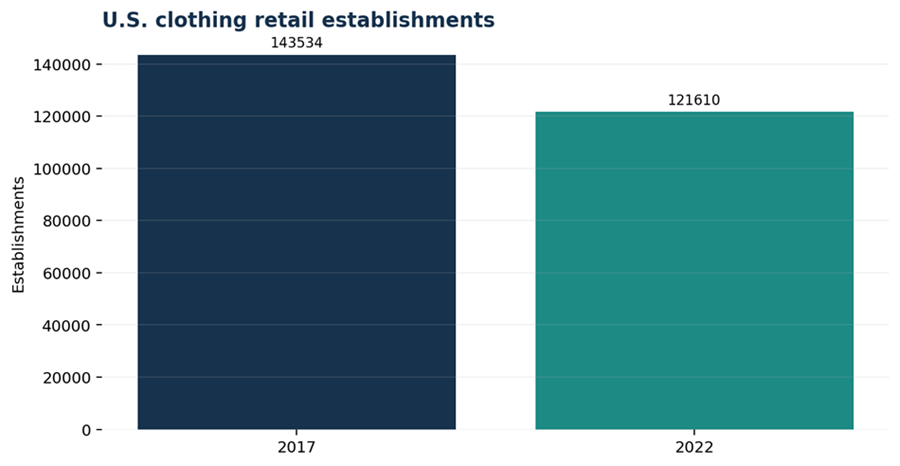
Physical clothing retail footprint contracted between economic censuses.
The Census Bureau estimated seasonally adjusted U.S. retail e-commerce sales of $326.7 billion in Q1 2026. E-commerce accounted for 16.9% of all retail sales and increased faster year over year than total retail. The measure covers all retail categories, not only apparel, so it should be used as channel context rather than a fashion-market size. For Gen Z Fashion Stores in USA, the implication is structural: inventory visibility, mobile checkout, delivery speed and returns are part of the store proposition. Physical shops can support fitting, pickup, returns, community events and immediate product access, while digital channels expand assortment and discovery.
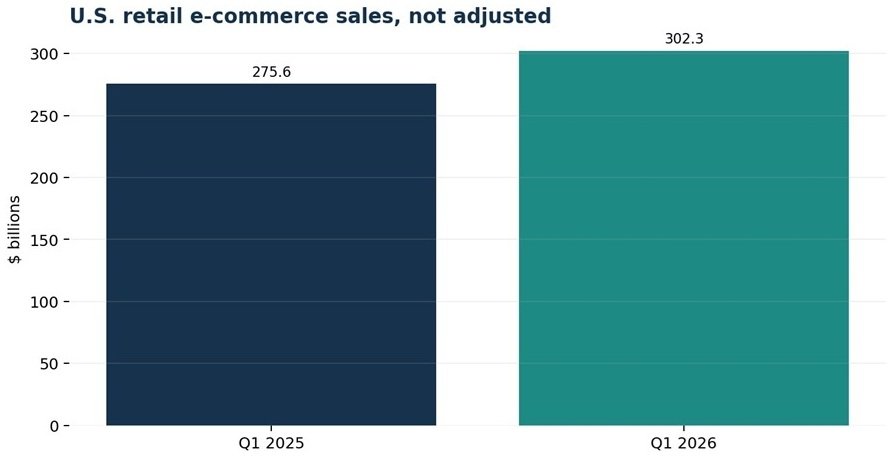
Not-adjusted U.S. retail e-commerce sales increased 9.7% year over year.
Pew’s 2025 survey provides a strong indicator of where younger adult customers can encounter fashion content. Platform use among ages 18–29 reached 95% for YouTube, 80% for Instagram, 68% for Facebook, 63% for TikTok and 58% for Snapchat. These figures measure platform use, not shopping or purchase conversion. The practical lesson for Gen Z Fashion Stores in USA is to separate reach from sales. High platform adoption can support creator content, styling demonstrations and product discovery, but retailers still need first-party measures such as product-page visits, store-locator use, conversion, repeat purchase and returns.
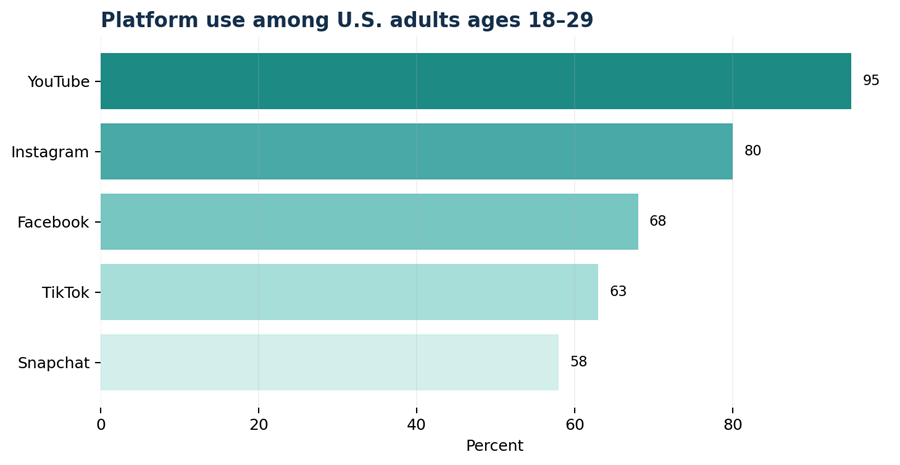
Younger adults have high reach across visual and video platforms.
There is no authoritative national ranking of Gen Z Fashion Stores in USA. The following examples are included because they sell categories commonly purchased by younger consumers and publish verifiable disclosures. They are not presented as a popularity league table for Gen Z Fashion Stores in USA.
| Retail concept | Latest verifiable signal | Interpretation |
| American Eagle / Aerie | AEO Q1 FY2026 revenue $1.2B; Aerie comps +25% | Strong recent momentum in intimates, activewear and lifestyle categories |
| Urban Outfitters / Free People | URBN eleven-month sales +11% through Dec. 2025 | Growth across digital and store channels |
| lululemon | 2025 revenue $11.1B; Americas revenue −1% | Large athletic-apparel base, but softer Americas performance |
| H&M | More than 4,000 stores globally across the group | Large accessible-fashion network; global count is not a U.S.-only figure |
| Resale platforms and stores | Gen Z and millennials projected to drive 70% of resale growth | Secondhand is an increasingly important competitive channel |
Source: AEO Inc. Q1 FY2026 release; Urban Outfitters Inc. January 2026 holiday sales release; lululemon 2025 results; H&M Group company profile; ThredUp 2026 Resale Report. Metrics use different periods and are not directly comparable.
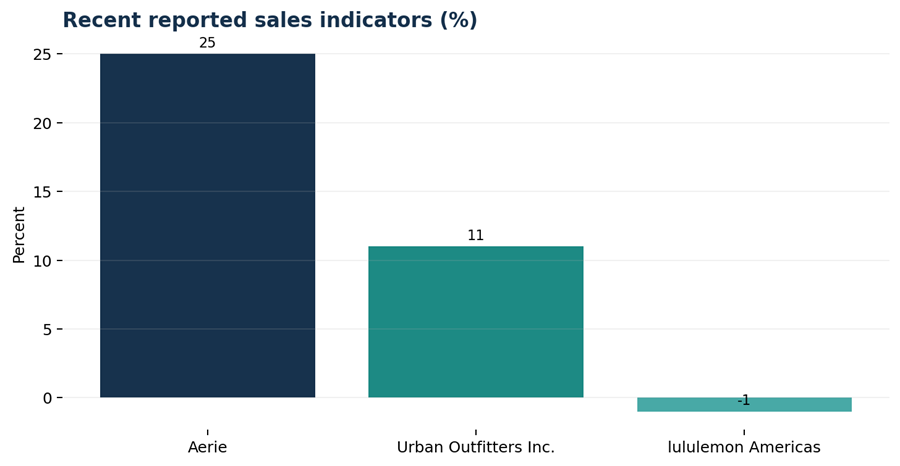
Selected recent growth indicators show uneven brand momentum.
Gen Z is not a single fashion segment. Age, income, gender, geography and life stage affect basket size and category choice. Younger teens may depend on household spending, while older Gen Z consumers may buy workwear, occasionwear, activewear and home-related goods alongside fashion. Gen Z Fashion Stores in USA need segmentation that reflects these differences. Retailers competing for this audience typically organize the proposition around several measurable needs:
The 2026 resale report indicates that younger generations will be central to future secondhand growth. Its forecast that Gen Z and millennials will drive 70% of market growth is a projection from an industry-sponsored report, not an official statistic. It nevertheless provides a useful directional signal when paired with observed platform expansion and retailer resale initiatives. For Gen Z Fashion Stores in USA, resale competes on price, uniqueness and circularity. New-product retailers can respond with better durability, transparent materials information, trade-in programs, limited drops, repair services or partnerships. The right approach depends on economics; sustainability messaging alone does not prove lower environmental impact.
BLS reported that apparel prices in 2024 were essentially at the same level as in 1994, even though the overall consumer price index rose substantially across the same period. This long-run comparison highlights the competitive and globalized nature of apparel pricing. It does not mean every garment or brand remained unchanged in price or quality. The 2024 Consumer Expenditure Survey is the latest complete annual release available in 2026. Age-based household data should be interpreted carefully because the survey reports consumer units by the age of a reference person, not individual Gen Z shoppers. Store strategy should therefore combine official household benchmarks with retailer transaction data.
The 2026 outlook for Gen Z Fashion Stores in USA is best described as omnichannel, video-led and value-sensitive. E-commerce is still expanding faster than total retail, but store sales can grow alongside digital sales, as the Urban Outfitters disclosure demonstrates. Strong Aerie performance also shows that clear category positioning can produce growth even when broader apparel conditions are mixed. Physical stores remain useful when they reduce uncertainty and friction. Fit, immediate availability, returns and social experience are difficult to reproduce completely online. The strongest operators will likely connect those advantages to accurate digital inventory and a consistent mobile experience.
They are physical or online fashion retailers that meaningfully serve U.S. consumers born roughly from 1997 to 2012. There is no official industry classification for the term.
Using the 1997–2012 definition, Gen Z is approximately 14 to 29 years old during 2026.
No single authoritative, nationwide 2026 dataset establishes one winner. Popularity varies by category, price, geography and survey method.
Yes. Company disclosures show that store and digital sales can grow together. Stores remain relevant for fit, pickup, returns, discovery and immediate purchase.
U.S. e-commerce represented 16.9% of total retail sales in Q1 2026. This all-retail measure confirms the importance of digital commerce but is not apparel-specific.
In Pew’s 2025 survey, 95% of ages 18–29 used YouTube, 80% Instagram, 63% TikTok and 58% Snapchat.
Resale offers lower prices, unique inventory and a circular-use proposition. A 2026 industry report projects Gen Z and millennials will drive 70% of resale-market growth through 2030.
No. Gen Z spans teenagers through working adults. Income, household status and category influence price sensitivity and spending.
Useful metrics include full-price sell-through, return rate, repeat purchase, store-assisted digital sales, pickup usage, inventory accuracy and contribution margin.
Current evidence supports integration rather than simple replacement. Digital sales are expanding, while well-positioned retailers can still generate positive store sales.
Gen Z Fashion Stores in USA are competing across stores, websites, social platforms and resale channels at the same time. The 2026 evidence shows expanding retail e-commerce, extensive younger-adult use of visual platforms, a smaller broad clothing-store footprint than in 2017, and sharply different performance across individual retail concepts. The most defensible strategy is evidence-led: define the target segment precisely, measure omnichannel behavior, disclose claims carefully and distinguish observed data from forecasts. Gen Z Fashion Stores in USA that connect value, fit, convenience and credible product information are better positioned to serve a diverse generation without relying on stereotypes.

Market View Insights specializes in delivering comprehensive market research solutions across 120 industries.Detailed and insightful reports covering market trends, competitive analysis, consumer behavior, and more, providing valuable insights for informed decision-making.
 USA :India :
 sales@marketviewinsights.com
 +1-445-120-2050


 +1-445-120-2050


 Chemicals And Materials
 Consumer Goods
 Energy And Power
 Biotechnology
 Healthcare
 Medical Devices And Supplies
 Pharmaceuticals
 Food And Beverage
 Agriculture
 Automotive And Transportation
 Technology
 Semiconductors And Electronics
 Building And Construction
 Manufacturing
