ABB Statistics and Facts 2026
By Emily Martin
Introduction
ABB Group is a Swiss based global technology company focused on electrification and automation. The company provides products, systems, software, and lifecycle services that help industrial, utility, infrastructure, transport, and building customers distribute power, improve efficiency, automate operations, and manage complex assets.
The company is important because its portfolio sits close to several large structural trends, including grid modernization, industrial energy efficiency, data center power demand, smart buildings, process automation, electric transportation, and digital manufacturing. ABB serves customers in more than 100 countries and reported 111,900 employees at the end of 2025.
ABB Group operates through three main business areas after the planned separation of the robotics business from continuing operations: Electrification, Motion, and Automation. These areas cover electrical distribution products, motors, drives, generators, traction systems, process automation platforms, digital industrial software, and service programs.
ABB statistics are useful for industry readers because they show how demand is shifting across power distribution, industrial automation, data centers, renewable power conversion, and software enabled industrial services. The figures also help compare ABB with peers such as Schneider Electric, Siemens, Eaton, and Rockwell Automation.
Company Profile
| Profile Item |
Details |
| Company Name |
ABB Ltd, commonly referred to as ABB Group |
| Category / Industry |
Electrification, automation, industrial technology, electrical equipment, drives, motors, power distribution, process automation, and digital industrial systems |
| Company Type |
Public company |
| CEO |
Morten Wierod |
| CFO |
Christian Nilsson, effective February 1, 2026 |
| Founder |
ABB was formed through the merger of ASEA of Sweden and BBC Brown Boveri of Switzerland. Key predecessor founders were Ludvig Fredholm for ASEA, and Charles E. L. Brown and Walter Boveri for BBC. |
| Founded Year |
1988, with predecessor roots in 1883 and 1891 |
| Headquarters |
Zurich, Switzerland |
| Stock Symbol |
ABBN on SIX Swiss Exchange, ABB on Nasdaq Stockholm, and ABBNY as a U.S. OTC traded Level I ADR |
| Number of Employees |
111,900 employees at the end of 2025 |
| Annual Revenue |
USD 33.220 billion in 2025, based on continuing operations |
| Net Income |
USD 4.823 billion in total net income in 2025, including USD 4.734 billion attributable to ABB shareholders |
| Total Assets |
USD 44.885 billion as of December 31, 2025 |
| Products / Services |
Electrification products, medium-voltage and low-voltage equipment, switchgear, circuit breakers, UPS systems, drives, motors, generators, traction systems, industrial automation, distributed control systems, digital platforms, lifecycle services, and energy management solutions |
| Key Brands |
ABB Ability, ABB Ability System 800xA, Baldor-Reliance, Ty-Rap, T&B Liquidtight Systems, B&R Industrial Automation, Busch-Jaeger, and ABB E-mobility |
| Competitors |
Schneider Electric, Siemens, Eaton, Rockwell Automation, Emerson, Danfoss, WEG, Legrand, Vertiv, Yaskawa, FANUC, and Mitsubishi Electric |
| Subsidiaries |
Selected significant entities include ABB Inc., ABB Schweiz AG, ABB India Limited, ABB E-mobility Holding Ltd, ABB E-mobility Inc., ABB China Ltd, ABB Australia Pty Limited, ABB S.p.A., ABB AB, ABB France, ABB Oy, and B&R Industrial Automation GmbH |
| Website |
www.abb.com |
| Geographical Presence |
Operations in more than 100 countries with more than 160 manufacturing sites and a balanced revenue base across the Americas, Europe, and Asia, Middle East and Africa |
Editor's Choice
- ABB Group reported USD 33.220 billion in revenue in 2025 from continuing operations, compared with USD 30.583 billion in 2024 on the same reporting basis.
- Total orders reached USD 36.765 billion in 2025, up 17% from 2024, showing that order intake grew faster than reported revenue.
- Operational EBITA was USD 6.314 billion in 2025, while the operational EBITA margin reached 19.0%. This was 80 basis points higher than the prior year.
- Net income attributable to ABB shareholders increased to USD 4.734 billion in 2025, compared with USD 3.935 billion in 2024.
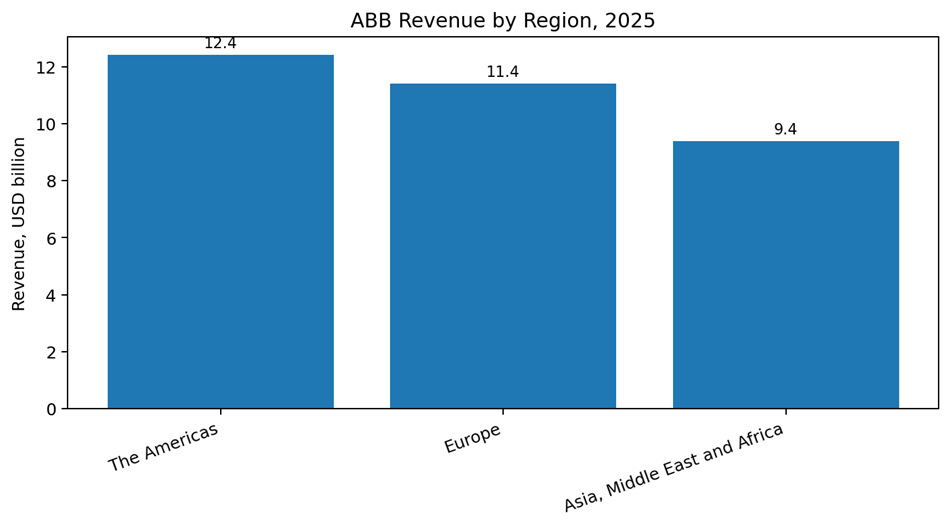
- The Americas was ABB Group's largest revenue region in 2025, generating USD 12.424 billion, ahead of Europe at USD 11.407 billion.
- Electrification remained the largest business area in 2025, generating USD 17.357 billion in total revenues before intersegment eliminations.
- ABB reported 111,900 employees at the end of 2025, including approximately 7,800 R&D employees, excluding R&D staff related to the Robotics business.
- The company had more than 160 manufacturing sites and completed 6 acquisitions in 2025, indicating a mix of organic expansion and targeted portfolio additions.
- Similarweb estimated abb.com at 3.2 million total visits in April 2026, with 4.02 pages per visit and an average visit duration of 4 minutes and 4 seconds.
- In Q1 2026, ABB reported USD 11.298 billion in orders and USD 8.734 billion in revenue, giving the company a strong start to 2026.
Historical Facts
- 1883: ASEA was founded in Sweden by Ludvig Fredholm. The company became one of the important early electrical engineering businesses in Northern Europe.
- 1891: Brown, Boveri & Cie was founded in Switzerland by Charles E. L. Brown and Walter Boveri. The company became active in motors, generators, transformers, and power technologies.
- 1974: ASEA introduced the IRB 6, which became known as the first fully electric, microprocessor controlled industrial robot offered commercially.
- 1988: ABB was formed through the merger of ASEA and BBC Brown Boveri. The merger created a large electrical engineering and automation group with operations across many countries.
- 1990s: ABB expanded in power, automation, industrial systems, and transportation through acquisitions and international restructuring.
- 1999: ABB shares were listed on the SIX Swiss Exchange and Nasdaq Stockholm, strengthening the company's public market presence in Europe.
- 2017: ABB completed the acquisition of B&R Industrial Automation, strengthening its machine and factory automation capabilities.
- 2018: ABB announced the sale of its Power Grids business to Hitachi, a move that later helped ABB sharpen its focus on electrification, motion, automation, and robotics.
- 2024: ABB increased acquisition activity, including transactions linked to wiring accessories, digital energy management, and power electronics.
- 2025: ABB announced the divestment of its Robotics division to SoftBank Group, moving the company toward a structure centered on electrification and automation.
General ABB Group Statistics and Facts
- ABB is headquartered in Zurich, Switzerland and operates as a publicly listed industrial technology company.
- The company describes itself as a technology leader in electrification and automation, serving industrial, building, utility, transport, and infrastructure customers.
- ABB had approximately 111,900 employees at the end of 2025, with operations spread across more than 100 countries.
- The company operated more than 160 manufacturing sites in 2025, supporting its local for local production strategy in key markets.
- ABB's continuing business is organized around Electrification, Motion, and Automation, following the reporting treatment of Robotics as discontinued operations.
- Electrification products include medium-voltage components, low-voltage components, switchgear, circuit breakers, enclosures, and digital energy management tools.
- Motion products include drives, motors, generators, traction solutions, and related services for industrial and infrastructure customers.
- Automation products include control systems, industrial software, distributed control systems, safety systems, marine and process automation, and lifecycle services.
- ABB's business model combines direct sales, distributors, channel partners, OEMs, EPC companies, utilities, panel builders, and system integrators.
- In Electrification, about half of business area revenue is generated through distributors, while about 20% comes from direct sales to end users.
- ABB reported 98% renewable electricity use in 2025, based on the company's annual reporting suite.
- ABB's Scope 1 and 2 greenhouse gas emissions were reported at 134 ktCO2e in 2025 on a market based basis.
- ABB assessed 46% of product based revenues against its circularity framework by the end of 2025 and reported 27% alignment.
- The company's brand position is supported by a large installed base, industrial domain knowledge, R&D investment, and broad geographic reach.
- ABB serves a business customer base rather than a mass consumer base, so its customer statistics are more relevant by sector, geography, and buying channel than by age or gender.
ABB Group Revenue Statistics
- ABB Group revenue from continuing operations reached USD 33.220 billion in 2025, an increase from USD 30.583 billion in 2024.
- Electrification generated USD 17.357 billion in total revenue in 2025 before intersegment eliminations, making it ABB's largest business area.
- Motion generated USD 8.247 billion in total revenue in 2025 before intersegment eliminations.
- Automation generated USD 8.084 billion in total revenue in 2025 before intersegment eliminations.
- Product revenue accounted for USD 27.669 billion in 2025, equal to about 83.3% of ABB's total revenue from continuing operations.
- Services and other revenue accounted for USD 5.551 billion in 2025, equal to about 16.7% of total continuing revenue.
- The Americas generated USD 12.424 billion in 2025 revenue, including USD 9.660 billion from the United States.
- Europe generated USD 11.407 billion in 2025 revenue, supported by growth across major markets such as Germany, Italy, Sweden, and the Netherlands.
- Asia, Middle East and Africa generated USD 9.389 billion in 2025 revenue, including USD 3.650 billion from China.
- Income from operations reached USD 6.047 billion in 2025, compared with USD 4.735 billion in 2024.
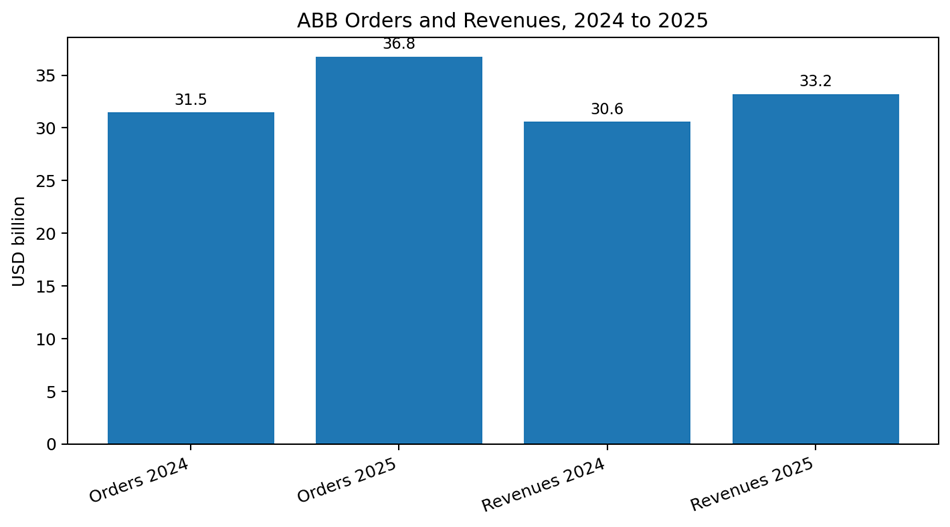
ABB Group Growth Statistics
- Total orders increased to USD 36.765 billion in 2025, compared with USD 31.482 billion in 2024.
- Comparable order growth was 15% in 2025, showing strong demand after adjusting for currency, acquisitions, and portfolio changes.
- Comparable revenue growth was 7% in 2025, indicating broad volume and mix improvement across the business.
- Operational EBITA increased 13% in 2025 to USD 6.314 billion.
- The operational EBITA margin improved to 19.0% in 2025 from 18.2% in 2024.
- Order backlog was USD 25.282 billion at the end of 2025, representing 27% growth from the previous year.
- Capital expenditures were USD 1.001 billion in 2025, compared with USD 799 million in 2024, reflecting higher investment in capacity and operational assets.
- Non order related R&D expenses were USD 1.318 billion in 2025, equal to 4.0% of revenue.
- ABB reported 6 acquisitions completed in 2025, supporting targeted portfolio expansion in electrification, software, and power electronics.
- Q1 2026 orders rose to USD 11.298 billion, up 32% in reported terms and 24% on a comparable basis, indicating continued demand momentum at the start of 2026.
ABB Group Regional Statistics
- The Americas was the largest revenue region in 2025, generating USD 12.424 billion and representing about 37.4% of group revenue from continuing operations.
- The United States generated USD 9.660 billion in 2025 revenue, making it ABB's largest single country market based on disclosed revenue.
- Europe generated USD 11.407 billion in 2025 revenue, equal to about 34.3% of total continuing operations revenue.
- Asia, Middle East and Africa generated USD 9.389 billion in 2025 revenue, equal to about 28.3% of total continuing operations revenue.
- China generated USD 3.650 billion in 2025 revenue, making it ABB's second major disclosed country market after the United States.
- In 2025, Americas revenue increased 9% in reported terms and 10% in local currencies, supported by strength in the United States and Canada.
- Europe revenue increased 13% in reported terms in 2025, while local currency growth was 7%.
- Asia, Middle East and Africa revenue increased 3% in reported terms in 2025, with growth in Australia, Saudi Arabia, Malaysia, and the United Arab Emirates partly offset by lower revenue in China and Singapore.
- In Q1 2026, orders grew 48% on a comparable basis in the Americas, 13% in Europe, and 10% in Asia, Middle East and Africa.
- ABB's local for local manufacturing model is strategically important in regions such as the United States, Europe, and China because it reduces supply chain distance and supports local customer needs.
Product / Service Statistics
- Electrification products cover medium-voltage and low-voltage systems, switchgear, digital devices, circuit breakers, enclosures, wiring accessories, and energy management systems.
- Smart Power products serve data centers, industrial plants, critical infrastructure, and commercial buildings with circuit breakers, low-voltage systems, motor starting applications, and UPS solutions.
- Smart Buildings products include building automation systems for HVAC, lighting, shutters, door entry, emergency lighting, and safe energy distribution.
- Installation Products includes well-known product lines such as Ty-Rap cable ties and T&B Liquidtight Systems protection products.
- Motion products include drives, motors, generators, traction technologies, power conversion equipment, and lifecycle services.
- Baldor-Reliance is an important ABB motor brand used in industrial motor applications, especially in North America.
- Automation products include ABB Ability System 800xA, Symphony Plus, Freelance DCS, Compact Product Suite, ABB Ability Genix, and ABB Care.
- Automation's offering is split approximately 60% toward new and brownfield projects and 40% toward service for the installed base.
- ABB's product revenue in 2025 was USD 27.669 billion, while services and other revenue was USD 5.551 billion.
- The Gamesa Electric power electronics acquisition added capabilities in wind converters, industrial battery energy storage systems, and utility scale solar inverters.
Sales Statistics
- ABB reported USD 36.765 billion in total orders in 2025, compared with USD 31.482 billion in 2024.
- The 2025 book to bill ratio was approximately 1.11, calculated from USD 36.765 billion in orders and USD 33.220 billion in revenue.
- The Americas produced USD 14.537 billion in 2025 orders, making it ABB's largest order region.
- Europe produced USD 12.169 billion in 2025 orders, while Asia, Middle East and Africa produced USD 10.059 billion.
- The United States produced USD 11.591 billion in 2025 orders, compared with USD 8.648 billion in 2024.
- Electrification received USD 18.757 billion in 2025 orders, up 14% from USD 16.422 billion in 2024.
- Motion received USD 8.619 billion in 2025 orders, up 8% from USD 7.989 billion in 2024.
- Automation received USD 9.928 billion in 2025 orders, up 33% from USD 7.485 billion in 2024.
- ABB's Q1 2026 book to bill ratio was 1.29, supported by USD 11.298 billion in orders and USD 8.734 billion in revenue.
- Sales channels vary by segment, with Electrification relying heavily on distributors and channel partners, while Automation is sold mainly through direct sales with a smaller share through partners and distributors.
Competitors and Market Share
- ABB competes across several overlapping markets, so its overall market share cannot be accurately represented by one single public percentage.
- In electrification and energy management, ABB competes closely with Schneider Electric, Siemens, Eaton, Legrand, Vertiv, Hubbell, and nVent.
- In drives, motors, and motion control, ABB competes with Siemens, Danfoss, WEG, Toshiba, Innomotics, Schneider Electric, and Wolong.
- In process automation and industrial control, ABB competes with Siemens, Emerson, Honeywell, Yokogawa, Rockwell Automation, and Schneider Electric.
- Schneider Electric reported revenue above EUR 40 billion in 2025, making it larger than ABB by reported annual sales in the broad electrification and automation space.
- Siemens reported EUR 78.9 billion in revenue for fiscal 2025, but its portfolio includes wider businesses such as mobility, software, smart infrastructure, and healthcare interests.
- Eaton reported USD 27.4 billion in 2025 revenue, making it smaller than ABB by total revenue but highly competitive in power management and electrical equipment.
- ABB's competitive position is strongest where electrification, automation, drives, and digital industrial services are combined in complex industrial or infrastructure projects.
- ABB's 2025 revenue base was geographically balanced, with no single region representing more than 38% of continuing revenue.
- ABB's planned divestment of the Robotics division to SoftBank reduces direct exposure to industrial robotics but sharpens focus on electrification and automation.
Shareholders or Ownership Statistics
- ABB Ltd is a publicly traded company incorporated under Swiss law and listed through registered shares in Switzerland and Sweden.
- ABB's registered shares trade under ABBN on the SIX Swiss Exchange and ABB on Nasdaq Stockholm.
- ABB also has a sponsored Level I ADR program traded in the United States under ABBNY on the OTC market.
- Investor AB was ABB's largest disclosed shareholder, with 265,385,142 ABB shares and 14.4% of voting rights as of March 31, 2026 according to ABB's major shareholders page.
- UBS Fund Management Switzerland AG disclosed 93,047,279 ABB shares, corresponding to about 5.001% of voting rights as of September 19, 2024.
- BlackRock Inc. disclosed 82,027,197 ABB shares, corresponding to about 4.17% of voting rights as of June 1, 2023.
- ABB reported a proposed dividend of CHF 0.94 per share for 2025, subject to shareholder approval at the 2026 annual general meeting.
- ABB announced a new share buyback program of up to USD 2.0 billion in 2026, replacing the earlier buyback program.
Patents or Innovation Statistics
- ABB reported R&D investment of USD 1.318 billion in 2025, compared with USD 1.268 billion in 2024.
- R&D spending represented 4.0% of 2025 revenue from continuing operations.
- ABB reported approximately 7,800 R&D employees in 2025, excluding R&D employees connected to the Robotics business.
- ABB states that its intellectual property portfolio includes more than 28,000 patents, protecting technologies across electrification, automation, digital systems, and industrial efficiency.
- ABB reported that absolute R&D investment had increased by about 30% since 2022.
- The company says around half of its global R&D workforce is focused on software, AI, and digital activities.
- ABB's innovation platforms include ABB Ability, ABB Ability Genix, System 800xA, digital energy management tools, advanced drives, and AI enabled industrial analytics.
- Innovation priorities are linked to power quality, energy efficiency, industrial reliability, predictive maintenance, grid resilience, AI data center power, and lifecycle service.
Collaboration and Partnership Statistics
- ABB and NVIDIA announced collaboration in 2025 to develop power solutions for next generation AI data centers, including work related to 800 VDC power architecture.
- In June 2026, ABB expanded the NVIDIA collaboration through integration of ABB power systems as SimReady 3D digital assets in NVIDIA Omniverse DSX Blueprint.
- ABB agreed in October 2025 to divest its Robotics division to SoftBank Group for a purchase price of USD 5.375 billion.
- ABB completed the acquisition of Siemens' wiring accessories business in China in March 2025, strengthening its smart buildings and wiring accessory portfolio in China.
- ABB completed the acquisition of the Gamesa Electric power electronics business in December 2025, adding renewable power conversion assets and approximately 46 GW of serviceable installed wind converter capacity.
- ABB announced the acquisition of Sensorfact in 2025 to expand its digital energy management offering for customers seeking consumption and efficiency improvements.
- ABB's Startup Challenge 2025 offered collaboration financing and access to energy technology networks for selected startups in smart power and digital energy areas.
- ABB works with distributors, OEMs, EPC contractors, system integrators, utilities, panel builders, and service partners as part of its global go to market model.
User or Customer Demographics
- ABB primarily serves business and institutional customers, not mass consumers, so customer demographics are best understood by sector, buying role, and geography.
- Industrial customers represent a large share of ABB's demand base, including oil and gas, chemicals, mining, metals, pulp and paper, food and beverage, pharmaceuticals, and battery manufacturing.
- The buildings market represents approximately one fifth of ABB's offering, with about two thirds focused on commercial buildings and one third on residential buildings.
- Transport and infrastructure customers represent approximately one seventh of ABB's customer base, including rail, marine, ports, data centers, airports, and infrastructure operators.
- Utility customers use ABB technologies for distribution networks, grid reliability, renewable power integration, and automation for conventional and low carbon power systems.
- Data center customers are increasingly important for ABB due to rising AI and cloud infrastructure power demand.
- Automation customers tend to be asset intensive companies that require high uptime, safe operations, process control, and lifecycle service.
- Electrification buyers include distributors, panel builders, contractors, utility customers, building owners, OEMs, EPC firms, and end users.
- Motion customers include factories, machine builders, marine operators, water and wastewater utilities, power generation companies, and transport operators.
- Customer purchase behavior is driven by reliability, energy efficiency, regulatory compliance, product availability, lifecycle cost, digital monitoring, and local service capacity.
Website and Social Media Traffic Statistics
- Similarweb estimated abb.com total visits at 3.2 million in April 2026.
- Similarweb estimated abb.com's April 2026 bounce rate at 41.58%.
- Similarweb estimated 4.02 pages per visit for abb.com in April 2026.
- The estimated average visit duration on abb.com was 4 minutes and 4 seconds in April 2026.
- Similarweb ranked abb.com at number 4 in the Heavy Industry and Engineering - Other category in the United States in April 2026.
- com was ranked around 16,243 globally by Similarweb in April 2026.
- Website traffic is mainly relevant to product research, investor information, careers, service support, industrial solutions, press releases, and technical documentation.
- ABB's LinkedIn company page snippet showed more than 4.3 million followers in 2026, reflecting a large professional audience.
- Social media engagement is especially useful for ABB's employer branding, technology news, sustainability updates, and product education campaigns.
- Website and social traffic numbers should be treated as third party estimates unless they are reported directly by ABB in its own analytics disclosures.
Employee Statistics
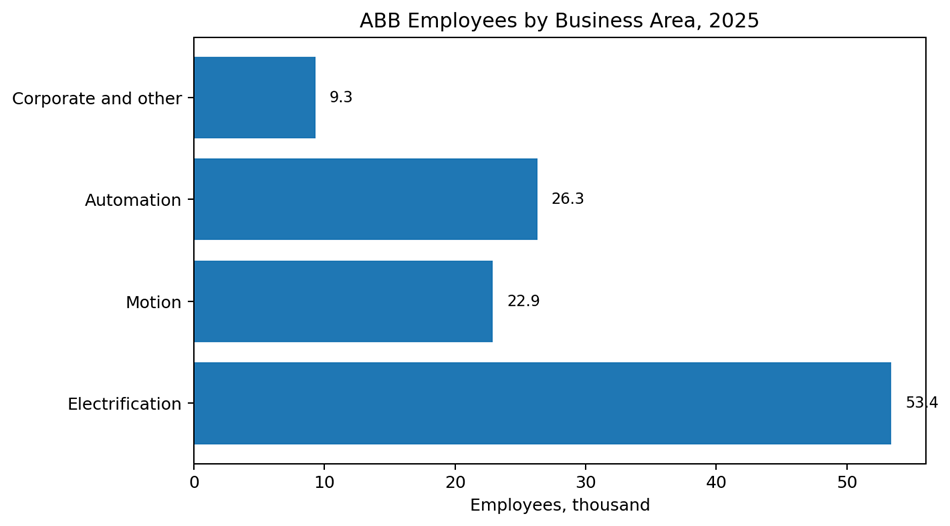
- ABB reported 111,900 employees at the end of 2025.
- Electrification had approximately 53,400 employees at the end of 2025, making it ABB's largest business area by workforce.
- Motion had approximately 22,900 employees at the end of 2025.
- Automation had approximately 26,300 employees at the end of 2025.
- Corporate and other functions accounted for an estimated 9,300 employees when business area headcounts are reconciled with total ABB headcount.
- ABB reported approximately 7,800 R&D employees in 2025, excluding R&D employees linked to the Robotics business.
- Women represented 27.8% of ABB's total workforce in 2025.
- Women represented 22.6% of senior management in 2025 where such data could be legally reported and included under ABB's methodology.
- ABB's R&D workforce is spread across approximately 30 countries on six continents, according to the company's innovation information.
- The company's decentralized operating model gives business areas and divisions significant accountability for customer performance, resource allocation, and operating results.
Fun Facts
- ABB's name comes from ASEA Brown Boveri, the two predecessor companies that merged in 1988.
- The company's history reaches back more than 140 years because ASEA was founded in 1883 and BBC was founded in 1891.
- ASEA's IRB 6 robot from 1974 is widely recognized as a pioneering fully electric, microprocessor controlled industrial robot.
- ABB technologies are used in applications ranging from data centers and factories to rail systems, ships, buildings, utilities, mines, and airports.
- ABB's Electrification business area alone generated more 2025 revenue than many standalone electrical equipment companies.
- ABB reported more than 160 manufacturing sites in 2025, showing the physical scale behind its global industrial footprint.
- The company's U.S. revenue in 2025 was larger than its total China revenue, making the United States the most important disclosed country market.
- ABB's website traffic is concentrated around practical industrial use cases, including product selection, technical documentation, service support, investor information, and career research.
Recent Developments
- In January 2025, ABB announced the acquisition of Sensorfact to expand its digital energy management offering.
- In March 2025, ABB completed the acquisition of Siemens' wiring accessories business in China, strengthening its position in smart building and wiring accessory products.
- In April 2025, ABB initially announced plans to spin off the Robotics division as a separately listed company.
- In October 2025, ABB agreed to sell its Robotics division to SoftBank Group for USD 5.375 billion, changing the earlier spin off plan.
- In October 2025, ABB announced Christian Nilsson as CFO and Executive Committee member effective February 1, 2026, succeeding Timo Ihamuotila.
- In December 2025, ABB completed the acquisition of Gamesa Electric's power electronics business, adding wind, solar, and battery energy storage power conversion capabilities.
- In January 2026, ABB reported record 2025 orders and revenue, proposed a CHF 0.94 dividend per share, and announced a share buyback program of up to USD 2.0 billion.
- In April 2026, ABB reported Q1 2026 orders of USD 11.298 billion and revenue of USD 8.734 billion, with strong demand across regions.
- In June 2026, ABB expanded its NVIDIA collaboration to support AI data center design through digital assets in NVIDIA Omniverse DSX Blueprint.
Future Predictions
- ABB is likely to become more focused on electrification and automation after the sale of the Robotics division, subject to closing conditions and regulatory approvals.
- Data center power demand is expected to remain a key growth area because ABB is expanding solutions for AI infrastructure power distribution, power quality, protection, and electrical architecture.
- The company's Motion business is expected to benefit from efficiency focused demand for motors, drives, generators, traction systems, and renewable power conversion.
- Automation demand is expected to remain linked to marine, ports, energy industries, mining, chemicals, water, and process industries where operational reliability is critical.
- R&D spending is likely to remain near the company's stated 4% to 5% of revenue range, with increasing emphasis on software, AI, digital systems, and electrification technologies.
- Regional growth is likely to be supported by the Americas and Europe, while Asia, Middle East and Africa may remain mixed due to differences in China, India, Gulf markets, and Southeast Asia.
- ABB's sustainability roadmap is expected to support demand for energy efficient products, circularity programs, renewable power conversion, and low carbon industrial solutions.
- Competitive pressure will remain high because Schneider Electric, Siemens, Eaton, and other peers are also investing strongly in data centers, electrification, AI enabled software, and industrial automation.
Conclusion
ABB Group entered 2026 with a strong financial and operating base. The company reported record levels of orders, revenues, operational EBITA margin, and free cash flow in 2025, while continuing to invest in R&D, manufacturing capacity, acquisitions, and portfolio simplification.
The statistics show that ABB is most exposed to electrification, industrial efficiency, automation, data center power demand, and energy transition related applications. Its regional revenue base is balanced, with the Americas leading in 2025 and the United States standing as the largest disclosed single country market.
Looking ahead, ABB's future direction is expected to be shaped by disciplined portfolio management, AI infrastructure power demand, industrial digitalization, service growth, and sustainability linked innovation. The outlook remains constructive, but competitive intensity and regional demand differences will continue to influence performance.
References:
- https://www.abb.com/global/en/company/annual-reporting-suite/key-figures
- https://library.e.abb.com/public/b32991481e8b4418a5c5261c5ff25440/ABB%20Financial%20Report%202025.pdf
- https://www.abb.com/global/en/company/about
- https://www.abb.com/global/en/company/about/history
- https://global.abb/group/en/investors/investor-and-shareholder-resources/share-listing
- https://global.abb/group/en/investors/investor-and-shareholder-resources/major-shareholders
- https://new.abb.com/news/detail/135137/q1-2026-results
- https://new.abb.com/news/detail/129997/abb-names-christian-nilsson-to-succeed-timo-ihamuotila-as-cfo
- https://new.abb.com/news/detail/129685/abb-to-divest-robotics-division-to-softbank-group
- https://new.abb.com/news/detail/131488/abb-completes-acquisition-of-power-electronics-business-of-gamesa-electric
- https://new.abb.com/news/detail/129805/abb-to-develop-next-generation-ai-data-centers-with-nvidia
- https://new.abb.com/news/detail/136274/abb-expands-collaboration-with-nvidia-through-integration-of-dsx-blueprint-for-ai-infrastructure
- https://www.similarweb.com/website/abb.com/
- https://www.se.com/ww/en/assets/564/document/528237/release-fy-results-2025.pdf
- https://assets.new.siemens.com/siemens/assets/api/uuid:6f0a40f1-9119-4007-b012-5b973b42574d/Annual-Financial-Report-FY2025.pdf
- https://www.eaton.com/content/dam/eaton/company/investor-relations/annual-report/eaton-2025-annual-report.pdf
- https://www.abb.com/global/en/company/stories/intellectual-property
- https://www.reuters.com/business/abb-gives-confident-outlook-2026-2026-01-29/


 USA :
USA : sales@marketviewinsights.com
 +1-445-120-2050


 +1-445-120-2050


 Chemicals And Materials
 Consumer Goods
 Energy And Power
 Biotechnology
 Healthcare
 Medical Devices And Supplies
 Pharmaceuticals
 Food And Beverage
 Agriculture
 Automotive And Transportation
 Technology
 Semiconductors And Electronics
 Building And Construction
 Manufacturing
