Walmart Statistics & Facts 2026
By Emily Martin
Introduction
Walmart is one of the largest retail and e-commerce companies in the world. The company operates physical stores, wholesale clubs, mobile apps, websites, fulfillment networks, and advertising platforms. Its business model is built around everyday low prices, high inventory turnover, grocery strength, and large-scale supply chain efficiency.
The company is structured around three main reporting segments: Walmart U.S., Walmart International, and Sam's Club U.S. Walmart U.S. is the largest segment and is heavily supported by grocery, health and wellness, general merchandise, store pickup, delivery, and Walmart Marketplace. Sam's Club operates as a membership-based warehouse club business, while Walmart International gives the company retail and digital exposure across markets outside the United States.
Walmart's 2026 strategy is centered on omnichannel retail. Stores are being used as shopping locations, fulfillment hubs, return centers, and delivery nodes. Online grocery, marketplace assortment, Walmart+, retail media, automation, and AI are being used to improve customer convenience and operating efficiency.
Company Profile
|
Profile Item
|
Details
|
|
Company Name
|
Walmart Inc.
|
|
Industry
|
Retail, grocery, e-commerce, wholesale club, and retail media
|
|
Founded
|
July 2, 1962
|
|
Founders
|
Sam M. Walton and James L. Walton
|
|
Headquarters
|
Bentonville, Arkansas, United States
|
|
CEO
|
John Furner, President and Chief Executive Officer
|
|
CFO
|
John David Rainey, Executive Vice President and Chief Financial Officer
|
|
Chairman
|
Gregory B. Penner
|
|
Stock Ticker
|
WMT, Nasdaq
|
|
Revenue
|
USD 713.163 billion in FY2026
|
|
Net Income
|
USD 21.893 billion attributable to Walmart in FY2026
|
|
Total Assets
|
USD 284.668 billion as of January 31, 2026
|
|
Number of Employees
|
Approximately 2.1 million associates worldwide, including about 1.6 million in the United States
|
|
Number of Stores
|
10,955 retail units as of January 31, 2026
|
|
Key Competitors
|
Amazon, Costco, Target, Kroger, Aldi, Dollar General, Home Depot, Best Buy, and major regional supermarkets
|
|
Official Website
|
www.walmart.com and corporate.walmart.com
|
Editor's Choice
- Walmart reported USD 713.163 billion in total revenue in FY2026, up 7% from FY2025.
- The company generated USD 706.413 billion in net sales and USD 21.893 billion in net income attributable to Walmart in FY2026.
- Walmart operated 10,955 retail units at the end of FY2026, including 4,611 Walmart U.S. stores, 601 Sam's Club U.S. locations, and 5,743 international units.
- Around 280 million customers and members visit Walmart stores, clubs, and e-commerce platforms each week across 19 countries.
- Walmart employed about 1 million associates worldwide, including around 1.6 million in the United States.
- Walmart U.S. grocery net sales reached USD 285.482 billion in FY2026, making grocery the largest category within the U.S. business.
- Company-level e-commerce net sales were about USD 150.4 billion in FY2026 when the three reported segment e-commerce figures are combined.
- Walmart U.S. e-commerce net sales were USD 99.6 billion in FY2026, compared with USD 79.3 billion in FY2025 and USD 65.4 billion in FY2024.
- Walmart does not disclose official Walmart+ subscriber numbers, but public consumer tracking estimates placed U.S. Walmart+ usage at roughly 30 million to 31 million members in early 2026.
- Walmart does not disclose official Marketplace seller counts, but public marketplace tracking estimates indicate more than 150,000 active sellers on Walmart Marketplace in 2026.
Historical Facts
- Walmart began in 1962, when Sam Walton opened the first Walmart Discount City in Rogers, Arkansas.
- The company became publicly traded in 1970, which helped fund expansion beyond its early regional base.
- The first Sam's Club opened in 1983, giving Walmart a membership-based warehouse club format.
- The first Walmart Supercenter opened in 1988, combining general merchandise with a full grocery store.
- Walmart started its international expansion in 1991 through a joint venture in Mexico.
- Walmart launched com and Samsclub.com in 1996, marking an early step into e-commerce.
- The first Neighborhood Market opened in 1998, adding a smaller grocery-focused format to the store portfolio.
- The company introduced Site to Store in 2007, an early omnichannel service that connected online orders with physical stores.
- Walmart launched Walmart+ in 2020, strengthening its membership, delivery, fuel savings, and digital shopping strategy.
- By 2026, Walmart was using automation, AI, retail media, store fulfillment, and private brand updates to support its next stage of retail growth.
General Walmart Statistics and Facts
- Walmart serves customers through more than 10,900 stores and clubs, e-commerce websites, and mobile platforms in 19 countries.
- The company operated 10,955 retail units at the end of FY2026, compared with 10,771 at the end of FY2025.
- Walmart's global retail footprint covered approximately 057 billion square feet as of January 31, 2026.
- Walmart had 371 distribution facilities worldwide, including 192 in the United States and 179 in international markets.
- The company had pickup or delivery services available at more than 8,400 locations
- Walmart's major product categories include grocery, health and wellness, general merchandise, fuel, apparel, home, electronics, consumables, and private-label products.
- Grocery remained the company's largest U.S. sales category, with USD 285.482 billion in Walmart U.S. grocery net sales in FY2026.
- Walmart's private-label business includes major brands such as Great Value, Equate, Mainstays, Marketside, and Member's Mark at Sam's Club.
- Walmart's capital expenditures reached USD 26.642 billion in FY2026, reflecting investment in stores, supply chain, technology, and fulfillment capacity.
- Walmart's pricing model remains based on everyday low prices and everyday low costs, which are used to attract value-focused customers.
- Third-party web traffic estimates suggest Walmart.com receives more than 400 million monthly visits in the United States during high-traffic months.
- The company's supply chain scale supports stores, clubs, online grocery, marketplace orders, last-mile delivery, and return logistics.
Walmart Sales Statistics
- Walmart's total revenue was USD 713.163 billion in FY2026, compared with USD 680.985 billion in FY2025.
- Net sales were USD 706.413 billion in FY2026, up from USD 674.538 billion in FY2025.
- Walmart U.S. net sales reached USD 482.975 billion, representing the largest share of company net sales.
- Walmart International net sales reached USD 130.423 billion in FY2026, up 0% from the prior year.
- Sam's Club U.S. net sales reached USD 93.015 billion in FY2026, up 1% from FY2025.
- Walmart's gross profit was USD 171.018 billion in FY2026, with a reported gross profit margin of 2%.
- Operating income reached USD 29.825 billion in FY2026.
- Consolidated net income reached USD 22.270 billion, while net income attributable to Walmart was USD 21.893 billion.
- Walmart U.S. comparable sales increased 3% in FY2026, supported by grocery, health and wellness, e-commerce, and marketplace growth.
- In Q1 FY2027, Walmart reported USD 177.751 billion in total revenue, up 3% year over year.
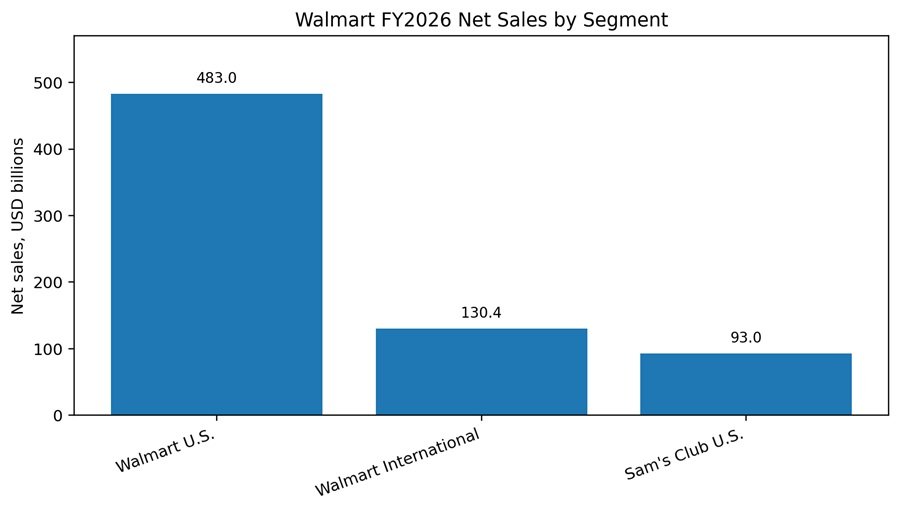
Walmart FY2026 Net Sales by Segment
Walmart Customer Statistics
- Walmart reaches around 280 million customers and members each week through stores, clubs, websites, and apps.
- Walmart is one of the most recognized retail brands in the United States, supported by broad store coverage and high grocery shopping frequency.
- Value-based shopping is central to Walmart's customer base because the company promotes everyday low prices across grocery, household essentials, and general merchandise.
- Grocery buyers are a major customer group, as Walmart U.S. grocery sales reached USD 285.482 billion in FY2026.
- Sam's Club also has a large grocery buyer base, with USD 64.706 billion in grocery and consumables net sales in FY2026.
- Digital customers are increasing as Walmart's combined reported e-commerce net sales reached approximately USD 150.4 billion in FY2026.
- In Q1 FY2027, Walmart U.S. comparable transactions rose 0%, showing higher customer activity across stores and digital channels.
- Walmart said Q1 FY2027 market share gains in the U.S. were led by upper-income households, which shows the company is gaining across more income groups.
- Delivery usage is rising, with Walmart reporting that store-fulfilled delivery has more than doubled over a two-year period.
- Membership-related loyalty is growing, as Walmart reported 4% growth in global membership fee revenue in Q1 FY2027.
Walmart Online Shopping Statistics
- Walmart's reported segment e-commerce net sales totaled approximately USD 150.4 billion in FY2026.
- Walmart U.S. e-commerce net sales reached USD 99.6 billion in FY2026, up from USD 79.3 billion in FY2025.
- Walmart International e-commerce net sales reached USD 35.8 billion in FY2026.
- Sam's Club U.S. e-commerce net sales reached USD 15.0 billion in FY2026.
- Global e-commerce sales increased 26% in Q1 FY2027, led by store-fulfilled pickup and delivery and marketplace growth.
- Walmart U.S. e-commerce sales increased 26% in Q1 FY2027, contributing about 530 basis points to comparable sales growth.
- Walmart International e-commerce sales increased 27% in Q1 FY2027, while Sam's Club U.S. e-commerce sales increased 23%.
- Walmart's digital shopping model includes Walmart.com, the Walmart app, online grocery, store pickup, delivery, marketplace products, and same-day fulfillment.
- The company said its U.S. delivery capability serves about 95% of U.S. households in under three hours.
- Third-party web traffic estimates placed Walmart.com at more than 400 million monthly visits in 2026, with the United States accounting for the majority of traffic.
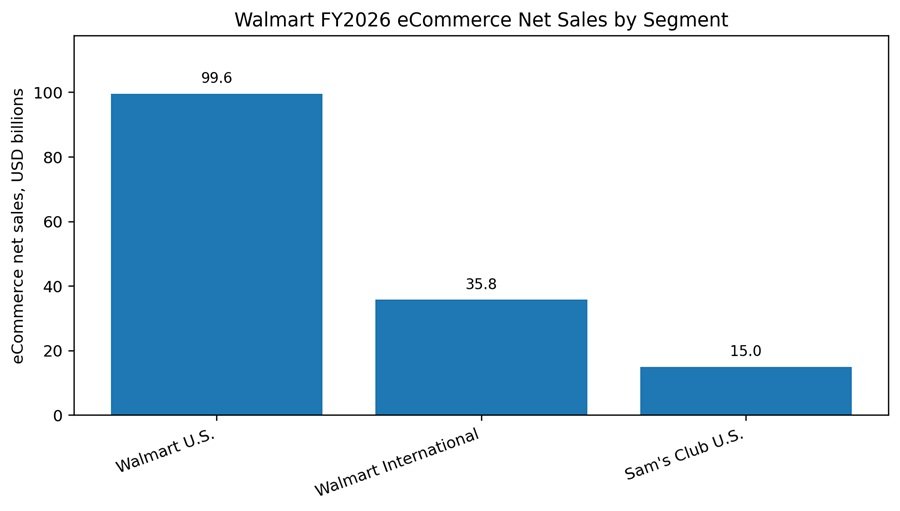
Walmart FY2026 eCommerce Net Sales by Segment
Walmart Store Statistics
- Walmart operated 10,955 retail units globally at the end of FY2026.
- The U.S. business included 4,611 Walmart U.S. retail units and 601 Sam's Club U.S. locations.
- Walmart International operated 5,743 units, including 5,398 retail units and 345 wholesale units.
- Walmart U.S. had 3,566 Supercenters, with an average store size of about 178,000 square feet.
- Walmart U.S. had 351 discount stores, with an average store size of about 104,000 square feet.
- Walmart U.S. had 694 Neighborhood Markets and other small formats, with an average size of about 42,000 square feet.
- Sam's Club U.S. had 601 clubs, with an average location size of about 134,000 square feet.
- Walmart owned 5,678 retail units and leased 5,277 retail units worldwide as of January 31, 2026.
- The company's total retail square footage was about 057 billion square feet in FY2026.
- S. stores remain central to fulfillment because they support in-store shopping, pickup, returns, same-day delivery, and local inventory availability.
Walmart Statistics by State
Walmart has a broad physical presence across the United States. State-level data is updated on different schedules than annual financial data, so the figures below should be read as 2025 state-level location and employment indicators where exact 2026 state-level totals were not officially disclosed. Walmart Location Facts pages state that retail-unit counts were reported as of August 2025 and associate figures as of July 2025.
- Texas, Florida, and California are among the largest Walmart states by total store count and workforce size.
- Texas is one of Walmart's largest state markets, with nearly 600 Walmart units in public 2025 state-level compilations.
- Major employment states include Texas, Florida, California, Arkansas, Georgia, North Carolina, and Illinois.
- State-level supplier impact is large because Walmart buys from thousands of local suppliers and supports supplier jobs outside its own workforce.
- Distribution center concentration is highest in large population and logistics states such as Texas, Florida, California, Pennsylvania, Indiana, and Georgia.
California Walmart Statistics
- Public state-level compilations report about 303 Walmart units in California, including Supercenters, discount stores, Neighborhood Markets, and Sam's Club locations.
- California Walmart operations employed about 102,498 associates in 2025 state-level data.
- The average full-time hourly field associate wage in California was reported at about USD 21.21.
- California had about 13 supply chain facilities serving Walmart customers.
- Walmart stores in California ordered from thousands of suppliers, with public compilations listing 3,868 local suppliers and more than 300,000 supplier jobs
Texas Walmart Statistics
- Public state-level compilations report about 592 Walmart units in Texas, making it one of Walmart's largest state markets.
- Texas had about 392 Supercenters, 96 Neighborhood Markets, 82 Sam's Club locations, and other Walmart formats in 2025 state-level data.
- Texas Walmart operations employed about 176,404 associates.
- The average full-time hourly field associate wage in Texas was reported at about USD 18.90.
- Texas had about 22 supply chain facilities and more than 2,500 local suppliers connected to Walmart operations.
Florida Walmart Statistics
- Public state-level compilations report about 387 Walmart units in Florida.
- Florida had about 232 Supercenters, 98 Neighborhood Markets, 46 Sam's Club locations, and other formats in 2025 state-level data.
- Florida Walmart operations employed about 119,545 associates.
- The average full-time hourly field associate wage in Florida was reported at about USD 19.16.
- Florida had about 14 supply chain facilities and more than 1,600 local suppliers connected to Walmart operations.
Alabama Walmart Statistics
- Public state-level compilations indicate Alabama has more than 140 Walmart units, including a large Supercenter presence.
- Alabama Walmart operations employed about 42,519 associates in 2025 state-level data.
- The average full-time hourly field associate wage in Alabama was reported at about USD 18.69.
- There was roughly one Walmart unit for every 36,068 residents in Alabama, based on public state-level estimates.
- Alabama had multiple supply chain facilities and hundreds of local suppliers connected to Walmart operations.
Arkansas Walmart Statistics
- Arkansas is Walmart's home state and the location of the company's headquarters in Bentonville.
- Public state-level compilations report about 127 Walmart units in Arkansas.
- Arkansas had about 76 Supercenters, 32 Neighborhood Markets, 10 Sam's Club locations, and other Walmart formats in 2025 state-level data.
- Arkansas Walmart operations employed about 59,602 associates.
- The average full-time hourly field associate wage in Arkansas was reported at about USD 18.67.
- Arkansas had about 8 supply chain facilities and close to 700 local suppliers connected to Walmart operations.
Walmart Marketplace Statistics
- Walmart Marketplace is the company's third-party seller platform and is used to expand online assortment without holding every item in Walmart-owned inventory.
- Walmart does not officially disclose the exact number of active Marketplace sellers in its annual filings.
- Public marketplace tracking estimates indicate more than 150,000 active sellers on Walmart Marketplace in 2026.
- Walmart's online marketplace has expanded product selection into hundreds of millions of items, according to public reports and Walmart marketplace commentary.
- Marketplace growth was one of the drivers behind Walmart's 26% global e-commerce growth in Q1 FY2027.
- Third-party sellers can use Walmart Fulfillment Services to outsource storage, shipping, and customer delivery support.
- Marketplace sellers can also use Walmart Connect advertising products to promote listings across Walmart digital properties.
- Compared with Amazon, Walmart Marketplace remains smaller, but it benefits from Walmart's store network, grocery traffic, and U.S. customer reach.
- Marketplace sales can improve assortment depth in categories such as home, apparel, electronics, toys, auto, outdoor, and general merchandise.
- The platform is expected to remain a major digital growth driver because it adds inventory breadth while supporting advertising and fulfillment revenue opportunities.
Walmart Revenue Statistics
- Walmart's total revenue increased from USD 572.8 billion in FY2022 to USD 713.2 billion in FY2026.
- FY2026 total revenue was USD 713.163 billion, compared with USD 680.985 billion in FY2025 and USD 648.125 billion in FY2024.
- FY2026 revenue grew 7% year over year, supported by comparable sales, grocery demand, health and wellness, e-commerce, and marketplace growth.
- Walmart U.S. net sales were USD 482.975 billion in FY2026, making it the company's largest revenue source.
- Walmart International net sales were USD 130.423 billion in FY2026.
- Sam's Club U.S. net sales were USD 93.015 billion in FY2026.
- Membership and other income totaled USD 6.750 billion in FY2026.
- Reported segment e-commerce net sales totaled approximately USD 150.4 billion in FY2026.
- The main revenue drivers were grocery, health and wellness, digital sales, membership income, advertising, and improved general merchandise trends.
- Walmart's Q1 FY2027 revenue of USD 177.751 billion showed continued sales momentum after the close of FY2026.
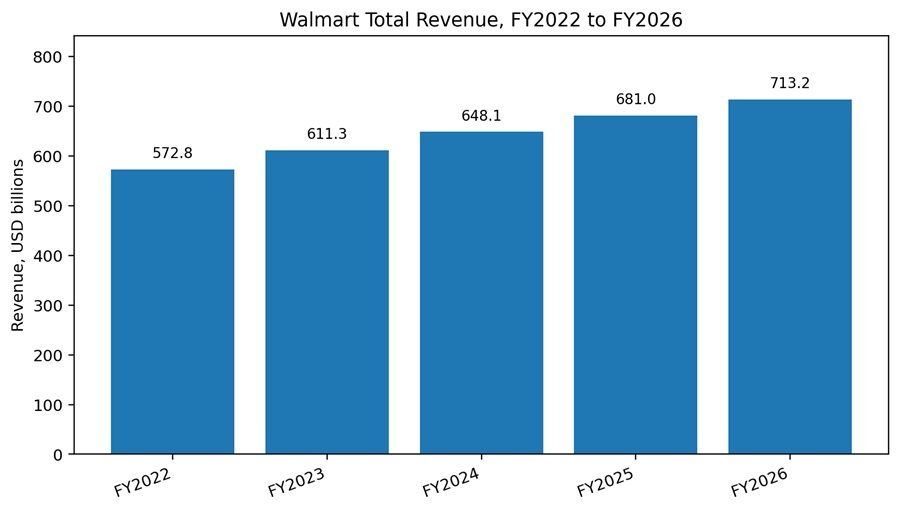
Walmart Total Revenue Trend, FY2022 to FY2026
Walmart Gross Profit Statistics
- Walmart reported USD 171.018 billion in gross profit in FY2026.
- The FY2026 gross profit margin was 2%, compared with 24.1% in FY2025 and 23.7% in FY2024.
- Walmart said the gross profit rate improved by 8 basis points in FY2026, supported by better inventory management and higher-margin business mix.
- Walmart U.S. generated an estimated USD 132.615 billion in gross profit, calculated from segment net sales and cost of sales in the FY2026 filing.
- Walmart International gross profit was USD 27.847 billion in FY2026.
- Sam's Club U.S. gross profit was USD 10.556 billion in FY2026.
- Higher-margin businesses such as advertising, membership, marketplace services, and data-related retail media are helping offset the lower-margin nature of grocery.
Walmart Plus Statistics
- Walmart+ is Walmart's paid membership program and is designed to support delivery, shipping, fuel savings, Scan & Go, and digital customer loyalty.
- Walmart launched Walmart+ in 2020 as a direct way to connect grocery delivery, online shopping, and member benefits.
- Walmart does not officially disclose the total number of Walmart+ subscribers in its annual filings.
- Public consumer tracking estimates placed Walmart+ usage at roughly 30 million to 31 millionS. members in early 2026.
- Paid subscriber counts are likely lower than usage estimates because some public measurements count shoppers who use access to the membership rather than only paying account holders.
- Walmart reported 4% growth in global membership fee revenue in Q1 FY2027.
- Walmart U.S. membership fee revenue grew by double digits in Q1 FY2027, and the company reported record first-quarter member net additions.
- Walmart+ supports online grocery adoption because many customers use the service for recurring household purchases, delivery, and store-to-door convenience.
- Walmart+ remains smaller than Amazon Prime, but it is strategically important because it links grocery frequency, digital orders, loyalty, and retail media opportunities.
Walmart Employee Statistics
- Walmart employed about 1 million associates worldwide in FY2026.
- The company employed about 6 million associates in the United States.
- The average U.S. hourly field associate made about USD 18.25 per hour, according to Walmart corporate workforce information.
- Walmart reports broad U.S. store and club pay ranges, including USD 14 to USD 37 per hour for team associates and USD 19 to USD 37 per hour for team leads.
- Supply chain associates had an average hourly wage of about USD 27 per hour, based on Walmart corporate workforce information.
- Supercenter store manager total annual pay can range from USD 218,000 to USD 530,000, depending on store size, performance, and compensation structure.
- Walmart has committed around USD 1 billion in career-driven training by 2026.
- The company reported that it has hired more than 400,000 veterans and military spouses since 2013.
- John Furner, Walmart's CEO in 2026, started his Walmart career as an hourly associate in 1993, which reflects the company's internal promotion culture.
- Automation and AI are expected to change associate tasks by reducing repetitive work and increasing the need for technology, logistics, and customer service skills.
Walmart Advertising and Retail Media Statistics
- Walmart Connect is Walmart's retail media and advertising business.
- Global advertising revenue grew 37% in Q1 FY2027.
- S. advertising revenue grew 36% in Q1 FY2027, while Walmart Connect excluding VIZIO grew 44%.
- Walmart International advertising revenue grew 32% in Q1 FY2027, led by growth in digital commerce markets.
- Walmart advertising placements appear across Walmart.com, the Walmart app, search results, product pages, in-store media, and connected TV-related inventory through VIZIO.
- Marketplace sellers are an important advertiser group because they can buy sponsored product placements to increase product visibility.
- Walmart's retail media advantage comes from first-party shopping behavior, purchase data, store traffic, and the ability to connect ad exposure with sales activity.
- Retail media is important to Walmart's profit mix because advertising is generally a higher-margin business than core grocery retail.
Walmart Supply Chain and Logistics Statistics
- Walmart operated 371 distribution facilities globally at the end of FY2026.
- The U.S. network included 192 distribution facilities, while international markets included 179 distribution facilities.
- Walmart had more than 8,400 pickup and delivery locations globally, making stores and clubs part of the fulfillment network.
- The company reported USD 26.642 billion in capital expenditures in FY2026, with investments across stores, distribution, fulfillment, technology, and automation.
- Walmart's U.S. stores help fulfill online orders, support same-day delivery, manage returns, and improve last-mile inventory availability.
- Walmart said U.S. delivery capability covers around 95% of households in under three hours.
- In Q1 FY2027, the company said store-fulfilled delivery had more than doubled over two years, and 36% of U.S. store-fulfilled delivery was completed in under three hours.
- Inventory was USD 58.851 billion at the end of FY2026 and USD 62.570 billion at the end of Q1 FY2027, showing the scale of product flow managed by the company.
Walmart Fun Facts
- Bananas are one of Walmart's top-selling items and are often recognized by the company as the single best-selling grocery product in its stores.
- The first Walmart Discount City opened in Rogers, Arkansas, in 1962.
- The first Sam's Club opened in 1983, and the first Walmart Supercenter opened in 1988.
- Walmart's global retail space exceeds 1 billion square feet.
- Around 280 million customers and members interact with Walmart stores, clubs, and e-commerce platforms each week.
- Walmart's U.S. grocery sales alone reached USD 285.482 billion in FY2026.
- The Great Value private brand update announced in 2026 covers nearly 10,000 food and consumable products over a phased rollout.
- Walmart's CEO John Furner began working for Walmart as an hourly associate in 1993.
- Walmart operates both traditional retail stores and membership clubs, including Walmart Supercenters, discount stores, Neighborhood Markets, and Sam's Club locations.
- Walmart trades on the Nasdaq under the ticker WMT.
Recent Developments
- In February 2026, John Furner became President and Chief Executive Officer of Walmart Inc.
- In 2026, Walmart announced leadership changes across Walmart U.S., Walmart International, Sam's Club U.S., and growth functions.
- In FY2026, Walmart revenue reached USD 713.163 billion, and the company crossed USD 150 billion in reported segment e-commerce net sales.
- In Q1 FY2027, Walmart reported USD 177.751 billion in revenue, with global e-commerce sales up 26% year over year.
- Walmart continued modernizing stores and using stores as local fulfillment hubs for pickup, delivery, and returns.
- In April 2026, Walmart announced a major Great Value brand refresh that covers nearly 10,000 food and consumable items over a phased rollout.
- The company continued expanding automation, AI, inventory technology, and faster delivery capabilities across retail and supply chain operations.
- Retail media remained a fast-growing area, with global advertising revenue up 37% in Q1 FY2027.
Walmart Future Predictions
- Walmart expects FY2027 net sales to grow 5% to 4.5% in constant currency, based on company guidance issued with Q1 FY2027 results.
- Adjusted operating income is expected to grow 6% to 8% in FY2027, according to Walmart guidance.
- E-commerce is likely to grow faster than total company sales because pickup, delivery, marketplace, and digital grocery are still expanding.
- Grocery delivery and faster fulfillment are expected to remain major growth areas because Walmart can use its store base as a local delivery network.
- Walmart Connect and retail media are likely to become more important profit drivers because advertising revenue is growing faster than total retail sales.
- AI, robotics, and automation are expected to support inventory planning, fulfillment speed, associate productivity, and customer experience.
- Walmart Marketplace is expected to attract more sellers as Walmart expands assortment, fulfillment services, and advertising tools.
- Store modernization will likely continue because physical stores remain essential for sales, pickup, delivery, returns, and local customer reach.
Conclusion
Walmart remains one of the most important companies in global retail. Its scale is supported by USD 713.163 billion in FY2026 revenue, nearly 11,000 retail units, around 2.1 million associates, and weekly reach across hundreds of millions of customers and members. The company's strength continues to come from grocery, price leadership, store density, Sam's Club, Walmart International, and a highly developed supply chain.
The next phase of Walmart's growth is expected to be shaped by e-commerce, Walmart Marketplace, Walmart+, retail media, AI, automation, and store-based fulfillment. The company's physical stores remain a major advantage, but digital services are becoming more important to revenue growth, customer loyalty, and operating efficiency.


 USA :
USA : sales@marketviewinsights.com
 +1-445-120-2050


 +1-445-120-2050


 Chemicals And Materials
 Consumer Goods
 Energy And Power
 Biotechnology
 Healthcare
 Medical Devices And Supplies
 Pharmaceuticals
 Food And Beverage
 Agriculture
 Automotive And Transportation
 Technology
 Semiconductors And Electronics
 Building And Construction
 Manufacturing
