Johnson and Johnson Statistics and Facts 2026
By Emily Martin
Company Profile
|
Profile Item
|
Details
|
|
Company Name
|
Johnson & Johnson
|
|
Category / Industry
|
Healthcare, pharmaceuticals, biotechnology, medical devices, and medical technology
|
|
Company Type
|
Public
|
|
CEO
|
Joaquin Duato, Chairman and Chief Executive Officer
|
|
CFO
|
Joseph J. Wolk, Executive Vice President and Chief Financial Officer
|
|
Founder
|
Robert Wood Johnson I, James Wood Johnson, and Edward Mead Johnson
|
|
Founded Year
|
1886
|
|
Headquarters
|
New Brunswick, New Jersey, United States
|
|
Stock Symbol
|
NYSE: JNJ
|
|
Number of Employees
|
Approximately 140,800 employees and 138,200 full-time equivalent positions in 2025
|
|
Annual Revenue
|
US$94.19 billion in reported sales in 2025
|
|
Net Income
|
US$26.80 billion in net earnings in 2025
|
|
Total Assets
|
US$199.21 billion at December 28, 2025
|
|
Products / Services
|
Innovative medicines, therapies, surgery products, orthopaedics, cardiovascular devices, vision products, and connected medical technology
|
|
Key Brands
|
DARZALEX, TREMFYA, STELARA, ERLEADA, CARVYKTI, SPRAVATO, TECNIS, ACUVUE, Ethicon, DePuy Synthes, Biosense Webster, Abiomed, Shockwave Medical
|
|
Competitors
|
Pfizer, Merck, Roche, Novartis, AstraZeneca, AbbVie, Eli Lilly, Bristol Myers Squibb, Medtronic, Stryker, Abbott, and Boston Scientific
|
|
Subsidiaries
|
Janssen companies, Ethicon, DePuy Synthes, Biosense Webster, Abiomed, Shockwave Medical, Intra-Cellular Therapies, and other operating subsidiaries
|
|
Website
|
https://www.jnj.com
|
|
Geographical Presence
|
The company conducts business in virtually all countries of the world, with major sales in the United States, Europe, Asia-Pacific, Africa, and the Western Hemisphere outside the United States
|
Introduction
Johnson & Johnson is one of the largest healthcare companies in the world. The company now operates through two main business groups: Innovative Medicine and MedTech. Its medicine business includes treatments for oncology, immunology, neuroscience, and cardiopulmonary diseases. Its medical technology business covers surgery, orthopaedics, cardiovascular care, and vision products.
The company has a strong role in the global healthcare supply chain because its products are used by hospitals, doctors, health systems, pharmacies, and patients across many countries. Its portfolio includes prescription therapies, surgical tools, implants, contact lenses, electrophysiology systems, and advanced devices used in complex medical procedures.
Johnson & Johnson’s business position changed after the separation of Kenvue, which moved the company away from consumer health and placed greater focus on medicines and medical technology. This makes its 2025 and 2026 figures important for readers who follow healthcare innovation, hospital purchasing, pharmaceutical competition, and medical device adoption.
The statistics in this article are useful because they show where Johnson & Johnson earns revenue, which products are driving performance, how its regional sales are distributed, and how the company is investing in employees, research, acquisitions, digital activity, and future growth areas.
Editor’s Choice
- Johnson & Johnson reported US$94.19 billion in worldwide sales in 2025, compared with US$88.82 billion in 2024, showing reported sales growth of 6.0%.
- The company reported US$26.80 billion in net earnings in 2025, compared with US$14.07 billion in 2024.
- Johnson & Johnson generated US$60.40 billion from Innovative Medicine and US$33.79 billion from MedTech in 2025.
- The United States was the largest geographic market in 2025, with US$53.75 billion in sales, equal to more than half of worldwide sales.
- The company had about 140,800 employees and 138,200 full-time equivalent positions as of December 28, 2025.
- Total assets reached US$199.21 billion at the end of 2025, up from US$180.10 billion at the end of 2024.
- In Q1 2026, Johnson & Johnson reported US$24.06 billion in sales, up 9% from US$21.89 billion in Q1 2025.
- The company raised its 2026 outlook after Q1 2026, with estimated reported sales of about US$100.8 billion at the midpoint.
- LinkedIn listed more than 2 million followers for Johnson & Johnson in 2026, supporting its strong professional audience reach.
- Estimated com monthly visits were around 2.15 million in April 2026, based on third-party web traffic estimates.
Charts and Visual Data
Historical Facts
- 1886: Johnson & Johnson was founded in New Brunswick, New Jersey by Robert Wood Johnson I, James Wood Johnson, and Edward Mead Johnson.
- 1888: The company introduced first aid products and antiseptic wound care items that helped build its early healthcare identity.
- 1890s: Johnson & Johnson expanded its consumer and medical care presence through sterilized surgical products, bandages, and maternity kits.
- 1910s: The company broadened its international operations and developed a stronger manufacturing and sales base outside the United States.
- 1944: Johnson & Johnson became a publicly traded company, creating a broader shareholder base and expanding access to capital.
- 1950s: The company increased its pharmaceutical activity and developed a wider healthcare portfolio beyond wound care and consumer products.
- 1961: Johnson & Johnson acquired Janssen Pharmaceutica, which later became a major part of its Innovative Medicine business.
- 1970s: Medical device operations grew through surgical and orthopaedic capabilities, including businesses that later became central to MedTech.
- 1990s: The company expanded through acquisitions and product launches in prescription medicine, medical devices, and diagnostics.
- 2000s: Johnson & Johnson strengthened its oncology, immunology, and device platforms through research programs and targeted business development.
- 2012: The company completed the acquisition of Synthes, which strengthened its orthopaedics and trauma portfolio.
- 2020: The company increased public attention through vaccine development, digital healthcare initiatives, and supply chain resilience work.
- 2023: Johnson & Johnson completed the separation of Kenvue, shifting its focus toward Innovative Medicine and MedTech.
- 2024: The company acquired Shockwave Medical, increasing its position in cardiovascular intervention.
- 2025: Johnson & Johnson acquired Intra-Cellular Therapies, adding CAPLYTA to its neuroscience portfolio, and it also announced or completed several product approvals and submissions.
- 2026: The company raised its full-year outlook after reporting US$24.06 billion in Q1 sales.
General Johnson and Johnson Statistics and Facts
- Johnson & Johnson operates through two reportable business segments: Innovative Medicine and MedTech.
- The company conducts business in virtually all countries of the world and focuses mainly on human health and well-being.
- In 2025, worldwide sales were US$94.19 billion, with US$53.75 billion from the United States and US$40.44 billion from international markets.
- Innovative Medicine represented about 64% of 2025 sales, based on US$60.40 billion out of US$94.19 billion in total sales.
- MedTech represented about 36% of 2025 sales, based on US$33.79 billion in segment sales.
- Johnson & Johnson reported US$199.21 billion in total assets at the end of 2025.
- The company’s main product groups cover oncology, immunology, neuroscience, cardiopulmonary medicine, cardiovascular devices, orthopaedics, surgery, and vision.
- Three wholesalers represented approximately 8%, 15.5%, and 11.1% of total gross revenues in 2025, showing the importance of large distribution partners.
- The company’s business model includes direct hospital sales, healthcare provider relationships, pharmacy channels, distributors, and specialty care networks.
- In 2025, 95% of global employees across 73 countries participated in the company’s Our Credo Survey.
- Johnson & Johnson was named to Fortune’s World’s Most Admired Companies list in 2026 for the 24th consecutive year.
- The company’s public communication channels are aimed at healthcare professionals, investors, patients, job seekers, suppliers, and policymakers.
- Its competitive position is supported by a large medicine pipeline, a broad medical technology base, strong cash generation, and established global distribution.
- The company’s sustainability and social impact work is reported through its Health for Humanity reporting framework.
- Johnson & Johnson remains one of the most widely followed healthcare companies by investors because its results reflect trends across medicines, devices, hospitals, and patient care.
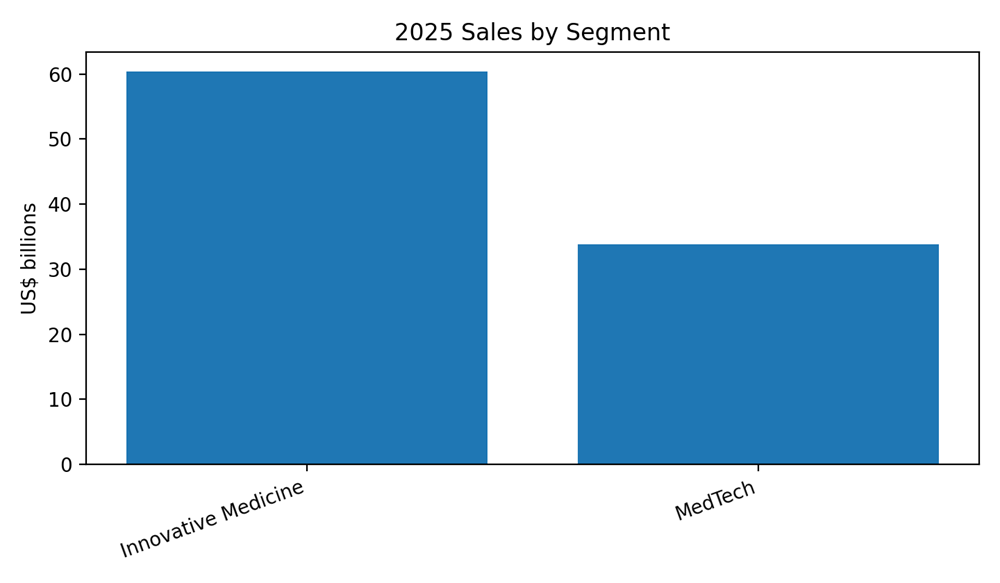
Innovative Medicine remained the larger segment in 2025, while MedTech provided a sizable second revenue base.
Johnson and Johnson Revenue Statistics
- Reported sales reached US$94.19 billion in 2025, up 0% from US$88.82 billion in 2024.
- Q4 2025 reported sales were US$24.56 billion, compared with US$22.52 billion in Q4 2024.
- Q1 2026 reported sales were US$24.06 billion, compared with US$21.89 billion in Q1 2025.
- Net earnings were US$26.80 billion in 2025, compared with US$14.07 billion in 2024.
- Diluted earnings per share were US$11.03 in 2025, compared with US$5.79 in 2024.
- Innovative Medicine sales were US$60.40 billion in 2025, up from US$56.96 billion in 2024.
- MedTech sales were US$33.79 billion in 2025, up from US$31.86 billion in 2024.
- United States sales were US$53.75 billion in 2025, while international sales were US$40.44 billion.
- Europe produced US$21.54 billion in 2025 sales, and Asia-Pacific, Africa produced US$14.03 billion.
- The company issued 2026 guidance in January 2026 with estimated reported sales of about US$100.5 billion at the midpoint, then lifted the midpoint to about US$100.8 billion after Q1 2026.
Johnson and Johnson Growth Statistics
- Worldwide reported sales grew 6.0% in 2025, while operational sales growth was 3%.
- Excluding STELARA, where sales were affected by loss of exclusivity, the company reported operational growth of 5% in 2025.
- Oncology sales increased to US$25.38 billion in 2025, up 1% from 2024.
- DARZALEX generated US$14.35 billion in worldwide 2025 sales, up 0% from 2024.
- CARVYKTI sales reached US$1.89 billion in 2025, up 9% from 2024.
- TREMFYA sales reached US$5.16 billion in 2025, up 5% from 2024.
- SPRAVATO sales reached US$1.70 billion in 2025, up 4% from 2024.
- Vision sales were US$5.47 billion in 2025, up 3% from 2024.
- MedTech sales grew 1% in 2025, supported by cardiovascular, surgery, orthopaedics, and vision product demand.
- Q1 2026 reported sales grew 9% year over year, helped by medicine and device portfolio performance.
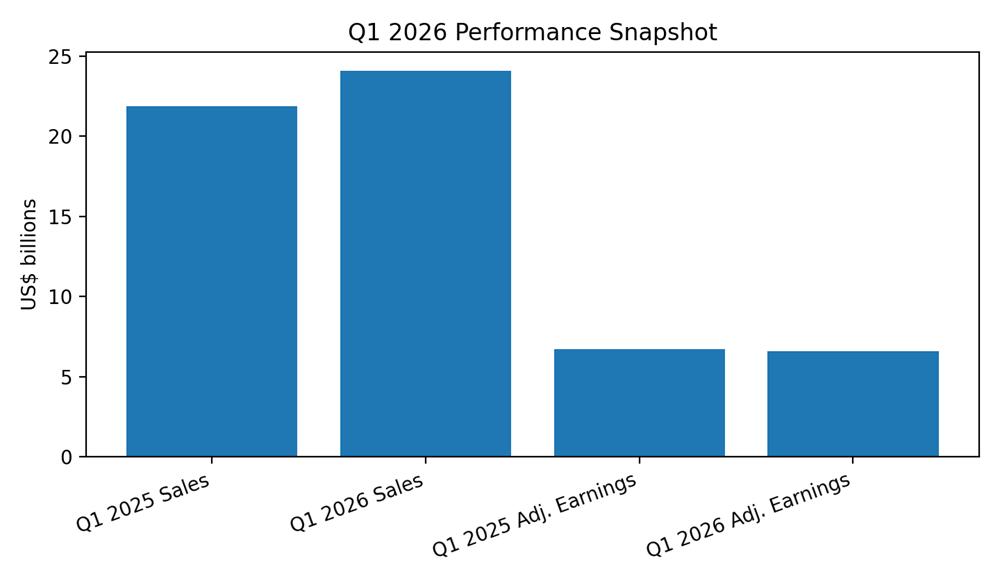
Q1 2026 sales increased year over year, while adjusted earnings were slightly lower than Q1 2025.
Johnson and Johnson Regional Statistics
- The United States was the largest region in 2025, with US$53.75 billion in sales.
- International markets generated US$40.44 billion in 2025 sales.
- Europe generated US$21.54 billion in 2025 sales, up from US$20.21 billion in 2024.
- Asia-Pacific, Africa generated US$14.03 billion in 2025 sales, up from US$13.59 billion in 2024.
- The Western Hemisphere excluding the United States generated US$4.88 billion in 2025
- United States sales increased 9% in 2025, while international sales increased 5.0%.
- In Q4 2025, the United States generated US$14.20 billion in sales, while international markets generated US$10.37 billion.
- The company’s U.S. performance was supported by oncology, neuroscience, immunology launches, and medical technology demand.
- Europe remained the second-largest region by sales and is an important market for advanced therapies and hospital technology.
- Asia-Pacific and Africa remain important long-term regions due to population scale, hospital investment, and demand for specialty care.
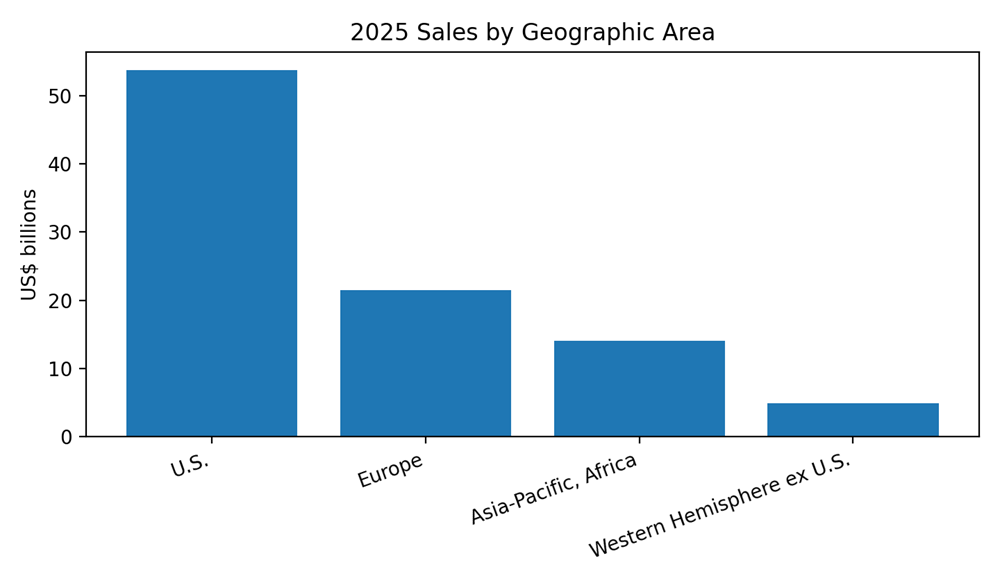
The United States was the largest geographic sales market in 2025, followed by Europe and Asia-Pacific, Africa.
Product / Service Statistics
- Oncology was the largest Innovative Medicine therapeutic area in 2025, with US$25.38 billion in worldwide sales.
- DARZALEX was one of the company’s top products in 2025, with US$14.35 billion in worldwide sales.
- STELARA sales declined to US$6.08 billion in 2025, down 3% from 2024 due to loss of exclusivity pressure.
- TREMFYA reached US$5.16 billion in worldwide 2025 sales and remained a key immunology growth product.
- ERLEADA generated US$3.57 billion in worldwide 2025
- SPRAVATO generated US$1.70 billion in worldwide 2025 sales, reflecting rising demand in neuroscience.
- CAPLYTA added US$700 million in 2025 sales after the Intra-Cellular Therapies acquisition.
- MedTech Vision sales reached US$5.47 billion in 2025, led by contact lenses and surgical vision products.
- The company’s surgery, orthopaedics, cardiovascular, and vision platforms serve hospitals, ambulatory centers, surgeons, ophthalmologists, and patients.
- In Q1 2026, Johnson & Johnson highlighted approvals and launches involving ICOTYDE, TECVAYLI plus DARZALEX FASPRO, VARIPULSE Pro in Europe, and TECNIS PureSee in the United States.
Sales Statistics
- Johnson & Johnson’s annual sales increased by US$5.37 billion from 2024 to 2025.
- The United States accounted for about 57% of 2025 sales based on US$53.75 billion out of US$94.19 billion.
- International markets accounted for about 43% of 2025 sales.
- Innovative Medicine U.S. sales were about US$36.34 billion in 2025, based on total U.S. sales less MedTech U.S. sales.
- MedTech U.S. sales reached US$17.41 billion in 2025, while MedTech international sales reached US$16.38 billion.
- The company’s three largest wholesalers represented a combined share of nearly half of total gross revenues in 2025.
- Q1 2026 sales were US$24.06 billion, putting the company on a strong run rate toward its 2026 guidance range.
- Medical products are sold through hospital systems, distributors, wholesalers, specialty pharmacies, direct sales teams, and professional healthcare networks.
- The company does not depend on a consumer retail model after the Kenvue separation, although some product touchpoints remain patient facing.
- Sales performance is influenced by patent cycles, clinical adoption, reimbursement access, regulatory approvals, hospital purchasing, and device procedure volumes.
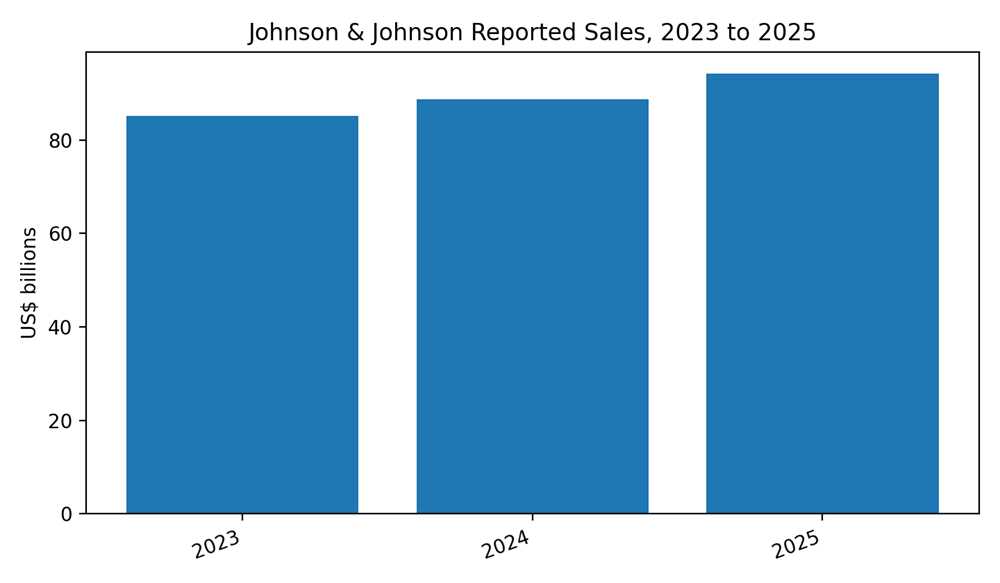
Johnson & Johnson reported sales increased from US$85.16 billion in 2023 to US$94.19 billion in 2025.
Competitors and Market Share
- Johnson & Johnson competes with large pharmaceutical companies such as Pfizer, UnitedHealth Group, Merck, Roche, Novartis, AstraZeneca, AbbVie, Eli Lilly, and Bristol Myers Squibb.
- In medical technology, major competitors include Medtronic, Stryker, Abbott, Boston Scientific, Zimmer Biomet, and Becton Dickinson.
- Johnson & Johnson’s 2025 sales of US$94.19 billion place it among the largest healthcare companies by annual revenue.
- The company’s strength is broader than a single drug class because it combines medicines with surgery, orthopaedics, cardiovascular, and vision technologies.
- In oncology, Johnson & Johnson competes through products such as DARZALEX, CARVYKTI, ERLEADA, RYBREVANT/LAZCLUZE, TALVEY, and TECVAYLI.
- In immunology, the company faces strong biosimilar and branded competition, especially after STELARA loss of exclusivity.
- In MedTech, the company competes on surgeon relationships, procedure outcomes, implant platforms, digital surgical systems, and device innovation.
- The company’s global geographic reach gives it an advantage in product launches, regulatory scaling, and hospital account coverage.
- Competitor pressure is expected to remain high because several rivals are investing in oncology, obesity, immunology, robotics, cardiology, and minimally invasive surgery.
- Johnson & Johnson’s position is supported by strong cash flow, large R&D spending, major acquisitions, and a long record of healthcare brand recognition.
Shareholders or Ownership Statistics
- Johnson & Johnson is a publicly traded company listed on the New York Stock Exchange under the symbol JNJ.
- The company has no parent company and is owned by public shareholders.
- The 2026 proxy statement identified Vanguard, BlackRock, and State Street as beneficial owners of more than 5% of common stock.
- Vanguard reported beneficial ownership of about 46 million common shares according to the 2026 proxy statement.
- BlackRock reported beneficial ownership of about 31 million common shares according to the 2026 proxy statement.
- State Street reported beneficial ownership of about 00 million common shares according to the 2026 proxy statement.
- All directors and executive officers as a group beneficially owned about 86 million shares in the 2026 proxy table.
- Institutional investors represent a major ownership group because Johnson & Johnson is widely held through index funds, mutual funds, pension funds, and long-term healthcare portfolios.
Patents or Innovation Statistics
- Research and development expense by segment totaled US$14.67 billion in 2025, based on US$11.83 billion for Innovative Medicine and US$2.84 billion for MedTech.
- The company’s R&D activity is concentrated in oncology, immunology, neuroscience, cardiopulmonary disease, cardiovascular technology, robotics, surgery, orthopaedics, and vision.
- Johnson & Johnson stated that no individual project represented more than 5% of annual consolidated R&D expense in the years presented, except a 2024 acquired in-process R&D expense related to NM26 rights.
- The company submitted the OTTAVA Robotic Surgical System in 2025, showing continued investment in robotic surgery.
- In 2026, Johnson & Johnson highlighted approvals and advances for ICOTYDE, TECVAYLI plus DARZALEX FASPRO, VARIPULSE Pro, and TECNIS PureSee.
- Innovation spending is supported by acquisitions such as Shockwave Medical and Intra-Cellular Therapies, which expanded cardiovascular and neuroscience platforms.
- Digital and data capabilities are important to the MedTech strategy, especially in robotics, electrophysiology, surgery planning, and connected care.
- The company’s patent position remains important because medicine exclusivity, device design, and biologic competition directly affect revenue durability.
Collaboration and Partnership Statistics
- Johnson & Johnson uses collaborations with biotechnology companies, universities, health systems, and technology partners to expand its research and device pipeline.
- The company records payments and reimbursements from collaborative development arrangements in its financial statements, showing that partnerships are part of its operating model.
- In 2025, Johnson & Johnson continued to advance products developed through internal science and external business development.
- The company’s supplier and distributor network is large, with three wholesalers representing significant shares of gross revenues in 2025.
- The acquisition of Intra-Cellular Therapies in 2025 expanded the neuroscience portfolio and added CAPLYTA sales to the company.
- The 2024 acquisition of Shockwave Medical strengthened the cardiovascular business and continued to contribute to MedTech growth in 2025.
- The company’s innovation centers support external partnering by connecting entrepreneurs and researchers with Johnson & Johnson scientific, commercial, and investment resources.
- Distribution partnerships remain essential because medicines and devices require regulated supply chains, specialized channels, and healthcare professional access.
User or Customer Demographics
- Johnson & Johnson customers include hospitals, surgeons, physicians, nurses, pharmacists, wholesalers, specialty pharmacies, health systems, and government health programs.
- Patients served by the company include people with cancer, immune-mediated diseases, neurological conditions, cardiovascular conditions, pulmonary hypertension, vision needs, and orthopaedic problems.
- The Innovative Medicine customer base is largely shaped by specialist physicians, payers, hospital systems, and patients requiring prescription therapies.
- The MedTech customer base is strongly linked to surgeons, electrophysiologists, ophthalmologists, orthopaedic specialists, hospital procurement teams, and ambulatory surgical centers.
- Demand is not limited to one age group because the company’s products serve children, adults, and older patients across different medical conditions.
- Higher usage is common among patients needing specialty treatments, surgical procedures, chronic disease care, cancer therapy, and vision correction.
- Website audiences include investors, job seekers, patients, caregivers, healthcare professionals, media readers, and suppliers.
- LinkedIn reach indicates a large professional audience, with more than 10.2 million followers listed in 2026.
- Digital traffic is partly influenced by investor earnings releases, career searches, disease education, product information, and corporate reputation content.
- Customer behavior is strongly shaped by clinical data, physician trust, reimbursement coverage, regulatory approval, hospital budgets, and treatment outcomes.
Website and Social Media Traffic Statistics
- Third-party estimates placed com at about 2.15 million website visits in April 2026.
- Estimated monthly visits were around 47 million in March 2026, around 2.20 million in February 2026, and around 2.19 million in January 2026.
- The company’s main website supports information for medicines, MedTech, careers, investors, media, sustainability, suppliers, and company history.
- Johnson & Johnson’s LinkedIn company page listed more than 2 million followers in 2026.
- The company’s main X account, JNJNews, listed about 242,000 followers in 2026.
- Johnson & Johnson Innovation’s X account listed about 32,000 followers in 2026.
- Digital traffic often increases during quarterly earnings, major regulatory approvals, acquisitions, product launches, and employment campaigns.
- Search traffic and direct visits are important because healthcare stakeholders often look for product, career, investor, and corporate responsibility information.
- The company’s digital reach is more professional and healthcare oriented than consumer retail focused after the Kenvue separation.
- Social media activity is used mainly for corporate news, science communication, hiring, patient stories, investor updates, and public health messaging.
Employee Statistics
- Johnson & Johnson had approximately 140,800 employees at December 28, 2025.
- The company reported approximately 138,200 full-time equivalent positions in 2025.
- The company reported approximately 139,800 employees and 138,100 full-time equivalent positions in 2024.
- In 2025, 95% of global employees across 73 countries participated in the Our Credo Survey.
- The survey was offered in 36 languages, showing the global nature of the workforce.
- The voluntary turnover rate was 8% in 2025.
- Johnson & Johnson states that its human capital strategy focuses on attracting and recruiting talent, developing and retaining talent, and empowering and inspiring talent.
- The company’s finance and global services organizations led by the CFO include approximately 9,000 colleagues around the world.
- The MedTech organization described under its worldwide chairman includes more than 75,000 employees.
- Technology employees support more than 135,000 employees across the company’s digital ecosystem, according to the CIO leadership profile.
Fun Facts
- Johnson & Johnson was founded in 1886, making it a healthcare company with more than 135 years of operating history.
- The company’s early products were linked to antiseptic surgery and first aid, which were critical needs in the late nineteenth century.
- The Johnson & Johnson name comes from two of the founding brothers, but three Johnson brothers were involved in the company’s founding story.
- The company’s headquarters remain in New Brunswick, New Jersey, where it was founded.
- Johnson & Johnson’s Credo has long been used as a guiding document for responsibilities to patients, customers, employees, communities, and shareholders.
- The company became public in 1944 and has remained one of the most widely recognized names in healthcare investing.
- Many of the company’s current brands are used mainly by healthcare professionals rather than consumers, especially after the Kenvue separation.
- The company’s product portfolio reaches from advanced cancer medicines to contact lenses, robotic surgery, orthopaedic implants, and cardiovascular devices.
Recent Developments
- In January 2026, Johnson & Johnson reported 2025 full-year sales of US$94.19 billion and issued 2026 sales guidance of about US$100.5 billion at the midpoint.
- In April 2026, the company reported Q1 2026 sales of US$24.06 billion, up 9% year over year.
- After Q1 2026, Johnson & Johnson raised its 2026 reported sales guidance midpoint to about US$100.8 billion.
- In 2025, the company acquired Intra-Cellular Therapies, adding CAPLYTA and strengthening its neuroscience portfolio.
- In 2025, Johnson & Johnson continued integrating Shockwave Medical, which was acquired in 2024 and added to the cardiovascular platform.
- The company highlighted ICOTYDE approval as the first targeted oral peptide for plaque psoriasis in its Q1 2026 update.
- Johnson & Johnson also highlighted VARIPULSE Pro in Europe and TECNIS PureSee for U.S. cataract patients in 2026.
- In 2026, the company was named to Fortune’s World’s Most Admired Companies list for the 24th consecutive year.
Future Predictions
- Johnson & Johnson is likely to keep focusing capital on Innovative Medicine and MedTech because these are now its two core business groups.
- Oncology is expected to remain one of the most important growth areas because DARZALEX, CARVYKTI, ERLEADA, and newer multiple myeloma and lung cancer products are still central to the portfolio.
- Immunology growth is expected to depend more on products such as TREMFYA and ICOTYDE as STELARA biosimilar competition continues to affect revenue.
- MedTech growth is likely to be supported by cardiovascular devices, electrophysiology, vision surgery, orthopaedics, and robotic surgery investments.
- Acquisitions may remain part of the company’s expansion strategy, especially in specialty medicine, cardiovascular technology, and differentiated device platforms.
- Digital adoption is likely to increase in medical devices through robotics, connected platforms, data-driven procedures, and surgeon workflow tools.
- The company’s global reach should help it scale approved medicines and devices across major regions, although pricing, regulation, and reimbursement will remain important constraints.
- Competitive positioning is expected to depend on clinical outcomes, launch execution, patent protection, product differentiation, and disciplined investment in research and development.
Conclusion
Johnson & Johnson remains a major healthcare company with a large global footprint, broad product portfolio, and strong financial base. In 2025, the company reported US$94.19 billion in sales, US$26.80 billion in net earnings, and US$199.21 billion in total assets. These figures show the scale of the business after its shift toward Innovative Medicine and MedTech.
The company’s statistics also show a clear change in growth drivers. Oncology, neuroscience, selected immunology products, cardiovascular devices, and medical technology platforms are becoming more important. At the same time, STELARA loss of exclusivity shows that patent cycles remain a major factor in pharmaceutical performance.
Overall, Johnson & Johnson’s future position is expected to be shaped by product approvals, specialty medicine growth, MedTech innovation, acquisitions, international demand, and effective management of pricing and regulatory pressures. Its 2026 results and raised guidance suggest that the company is entering the next phase with a focused healthcare model and a strong base for continued analysis.
References
- Johnson & Johnson 2025 Annual Report and Form 10-K, filed with the U.S. Securities and Exchange Commission: https://www.sec.gov/Archives/edgar/data/200406/000020040626000016/jnj-20251228.htm
- Johnson & Johnson Q4 and Full-Year 2025 Results Press Release, January 21, 2026: https://www.investor.jnj.com/investor-news/news-details/2026/Johnson--Johnson-reports-Q4-and-Full-Year-2025-results/default.aspx
- Johnson & Johnson Q1 2026 Results Press Release, April 14, 2026: https://www.jnj.com/media-center/press-releases/johnson-johnson-reports-q1-2026-results-raises-2026-outlook
- Johnson & Johnson Leadership Profiles: https://www.jnj.com/our-leadership-team
- Johnson & Johnson CFO Profile, Joseph J. Wolk: https://www.jnj.com/joseph-j-wolk
- Johnson & Johnson Corporate Website and Business Portfolio: https://www.jnj.com/
- Johnson & Johnson 2026 Proxy Statement: https://www.jnj.com/download/johnson-johnson-2026-proxy.pdf
- Johnson & Johnson LinkedIn Company Page follower count: https://www.linkedin.com/company/johnson-%26-johnson
- JNJNews X account follower count: https://x.com/JNJNews
- Johnson & Johnson Innovation X account follower count: https://x.com/JNJInnovation
- AltIndex web traffic estimates for jnj.com: https://altindex.com/ticker/jnj/webtraffic


 USA :
USA : sales@marketviewinsights.com
 +1-445-120-2050


 +1-445-120-2050


 Chemicals And Materials
 Consumer Goods
 Energy And Power
 Biotechnology
 Healthcare
 Medical Devices And Supplies
 Pharmaceuticals
 Food And Beverage
 Agriculture
 Automotive And Transportation
 Technology
 Semiconductors And Electronics
 Building And Construction
 Manufacturing
